Learn what every symbol on the card means.Full credits and sources at beakbrain.com/symbols
 ForestCavity nestMedium · 165 g




What the Rufous Motmot sounds like

ID tip
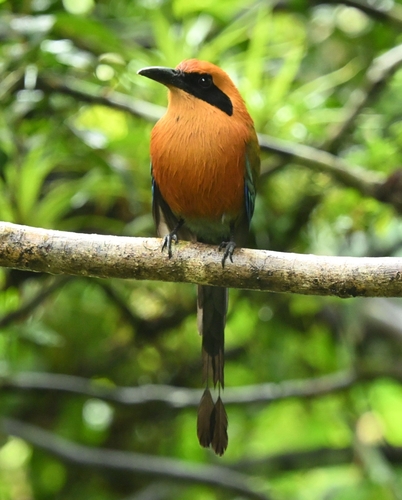
The rufous motmot is the second-largest member of its family. The male of the nominate subspecies is 42 to 47 cm (17 to 19 in) long and weighs 146 to 160 g (5.1 to 5.6 oz). The female weighs 153 to 173 g (5.4 to 6.1 oz). Male and female B. m. semirufus weigh 185 to 193 g (6.5 to 6.8 oz) and 170 to 208 g (6.0 to 7.3 oz) respectively. Adults are mainly cinnamon-rufous, with a black face mask and central breast spot, green wings and sides, a greenish-blue lower belly, and dark blue tail and flight feathers. The tail is very long, and that of B. m. Voice: The rufous motmot's song has been described as "hoos, hoots, or hoops". It is sometimes answered by a low owl-like hoop hoop huhuhuhuhuhu. An agitation call is a dry chatter.
Text from Wikipedia, licensed CC BY-SA 4.0.
When to see the Rufous Motmot
One bar for each month, and every month is filled: this bird is recorded here in all twelve. The wide bar is February, the month with the most records.
Where to see the Rufous Motmot
The map shades 9 countries with regular records. Everything unshaded has no records. Countries are listed below the map.
About the Rufous Motmot
The rufous motmot is a near-passerine bird in the family Momotidae. It is found from northeastern Honduras south to western Ecuador, northern Bolivia, and western Brazil.
Text adapted from Wikipedia, licensed CC BY-SA 4.0.
Easily confused with

Side by side: Rufous-capped Motmot vs Rufous Motmot
Learn the Rufous Motmot in the BeakBrain App
Photo and call practice. Coming soon to iPhone and Android.
Play today's Daily BirdEvery photo and recording on this page is credited to its author under the licence shown. Spotted a problem with this page, or have a better photo? Contribute.