Learn what every symbol on the card means.Full credits and sources at beakbrain.com/symbols
 ForestTiny · 11 g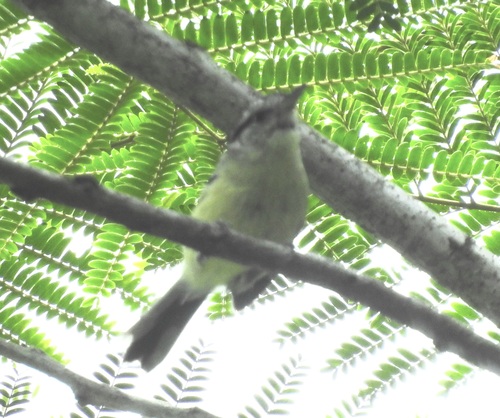
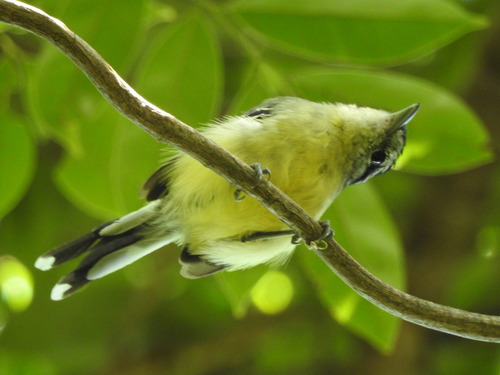
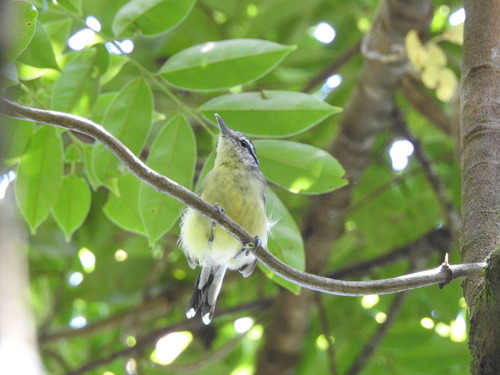
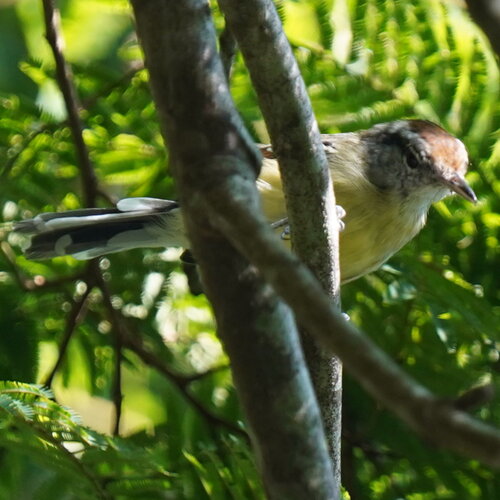
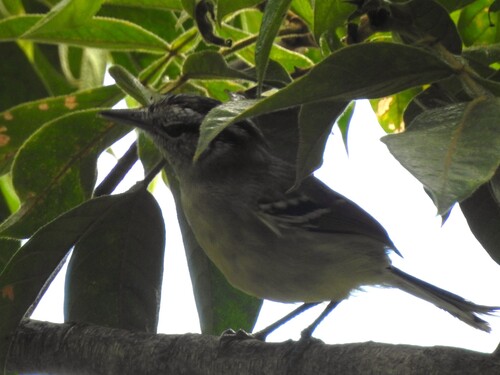
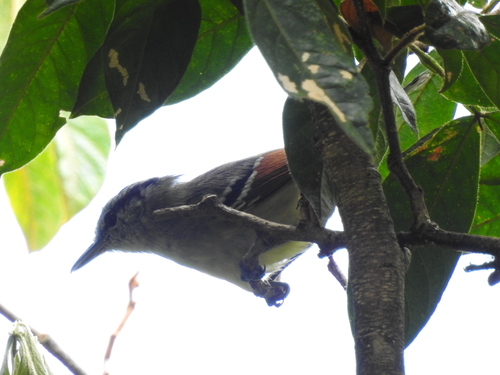
What the Rufous-margined Antwren sounds like

ID tip
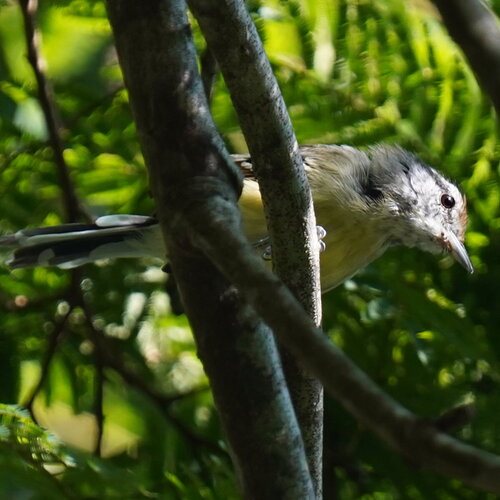
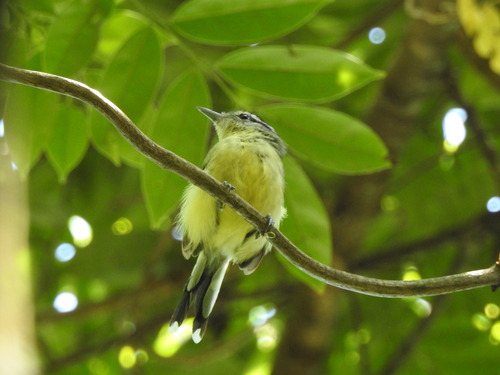
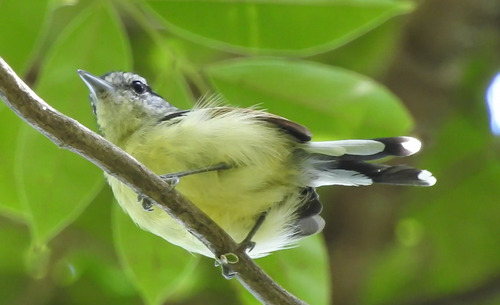
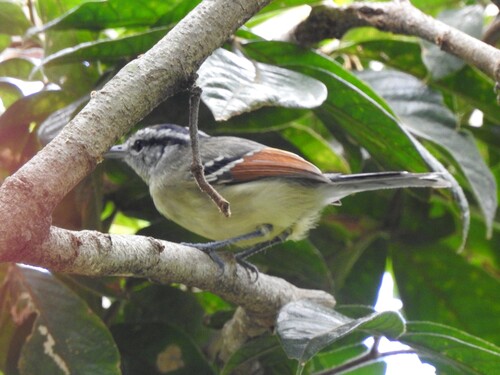
The rufous-margined antwren is 10 to 12.5 cm (3.9 to 4.9 in) long. Adult males have a black crown and nape, a wide whitish supercilium, a black stripe through the eye, and black and white or pale yellow mottled ear coverts. Their upperparts are mostly olive-gray with scattered black patches, yellow uppertail coverts, and white tips on their outer scapulars. Their wing coverts are black with white tips; their flight feathers are olive-brown tinged dark gray with bright cinnamon-rufous edges. Their tail is mostly dark gray with white tips on the feathers and an entirely white outermost pair. Voice: The rufous-margined antwren's song is "3‒4 slow-paced notes which rise in frequency, after which a series of fast notes gradually decelerates and drops again in pitch". Pairs often sing in duet. Its most common call is a "melodious whistled note tew" that may be repeated up to five times in a burst or irregularly over a longer period.
Text from Wikipedia, licensed CC BY-SA 4.0.
When to see the Rufous-margined Antwren
One bar for each month, and every month is filled: this bird is recorded here in all twelve. The wide bar is October, the month with the most records.
Where to see the Rufous-margined Antwren
The map shades 6 countries with regular records, and 3 more in a lighter tone where the bird turns up only as a stray. Everything unshaded has no records. Countries are listed below the map.
About the Rufous-margined Antwren
The rufous-margined antwren is an insectivorous bird in subfamily Thamnophilinae of family Thamnophilidae, the "typical antbirds." It is found in Argentina, Brazil, and Paraguay.
Text adapted from Wikipedia, licensed CC BY-SA 4.0.
Easily confused with
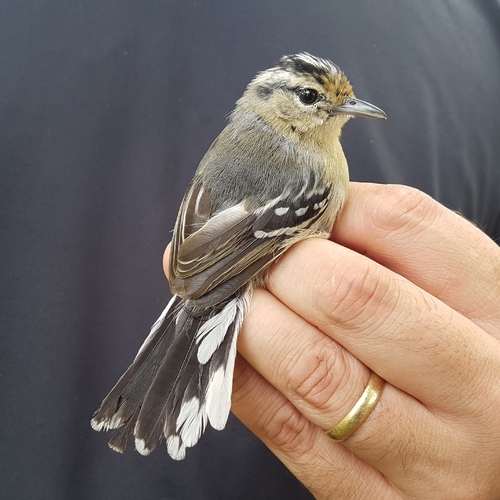 Black-capped AntwrenHerpsilochmus atricapillusThe black-capped antwren is 11 to 12 cm (4.3 to 4.7 in) long and weighs 8 to 11 g (0.28 to 0.39 oz).
 Rusty-winged AntwrenHerpsilochmus fraterThe rusty-winged antwren is 10 to 12.5 cm (3.9 to 4.9 in) long and weighs about 10 to 12.5 g (0.35 to 0.44 oz).
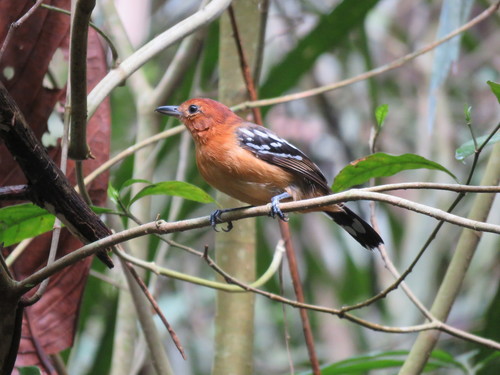 Large-billed AntwrenHerpsilochmus longirostrisThe large-billed antwren is 12 to 13 cm (4.7 to 5.1 in) long and weighs 12 to 14 g (0.42 to 0.49 oz).
Side by side: Black-capped Antwren vs Rufous-margined Antwren · Large-billed Antwren vs Rufous-margined Antwren
Learn the Rufous-margined Antwren in the BeakBrain App
Photo and call practice. Coming soon to iPhone and Android.
Play today's Daily BirdEvery photo and recording on this page is credited to its author under the licence shown. Spotted a problem with this page, or have a better photo? Contribute.