Learn what every symbol on the card means.Full credits and sources at beakbrain.com/symbols
 ForestCavity nestSmall · 21 g
What the Rufous-breasted Piculet sounds like

ID tip
The rufous-breasted piculet is 9 to 11 cm (3.5 to 4.3 in) long and weighs 12 to 21 g (0.42 to 0.74 oz). Adult males of the nominate subspecies have a black crown with wide red tips on most of the feathers and small white to buff spots on its sides and rear border. Their face, a narrow collar on their nape, and their underparts are rich orange rufous or rufous chestnut. Their upperparts are yellowish olive. Their flight feathers are dark with yellowish olive edges. Voice: The rufous-breasted piculet's song is "a slow, descending series of high, lisping notes (generally 2): seep seep." Its calls include "single quick seep notes or a rapid tsit tsit in flight."
Text from Wikipedia, licensed CC BY-SA 4.0.
When to see the Rufous-breasted Piculet
One bar for each month, and every month is filled: this bird is recorded here in all twelve. The wide bar is September, the month with the most records.
Where to see the Rufous-breasted Piculet
The map shades 4 countries with regular records, and 1 more in a lighter tone where the bird turns up only as a stray. Everything unshaded has no records. Countries are listed below the map.
Recorded as a rare visitor in Colombia.
About the Rufous-breasted Piculet
The rufous-breasted piculet is a species of bird in subfamily Picumninae of the woodpecker family Picidae. It is found in Bolivia, Brazil, Colombia, Ecuador, and Peru.
Text adapted from Wikipedia, licensed CC BY-SA 4.0.
Easily confused with
 White-bellied PiculetPicumnus spilogasterThe white-bellied piculet is 8 to 9.2 cm (3.1 to 3.6 in) long and weighs 7 to 12 g (0.25 to 0.42 oz).
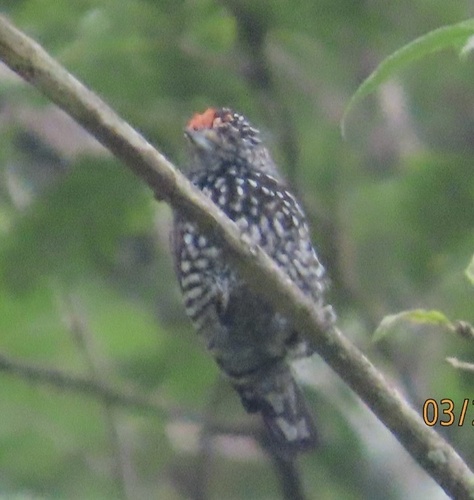 Speckle-chested PiculetPicumnus steindachneriThe speckle-chested piculet is 9 to 10 cm (3.5 to 3.9 in) long and weighs about 10 g (0.35 oz).
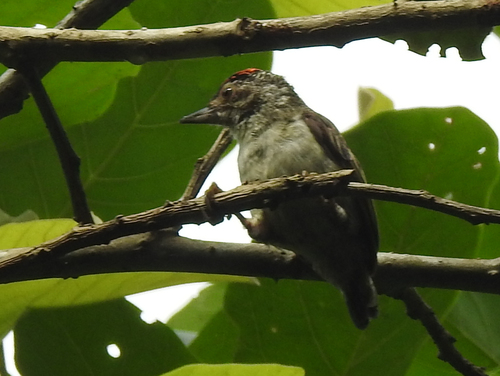 Plain-breasted PiculetPicumnus castelnauThe plain-breasted piculet is 8 to 10 cm (3.1 to 3.9 in) long and weighs about 11 to 12 g (0.39 to 0.42 oz).
Learn the Rufous-breasted Piculet in the BeakBrain App
Photo and call practice. Coming soon to iPhone and Android.
Play today's Daily BirdEvery photo and recording on this page is credited to its author under the licence shown. Spotted a problem with this page, or have a better photo? Contribute.