Learn what every symbol on the card means.Full credits and sources at beakbrain.com/symbols
 ForestDomed nestTiny · 9 g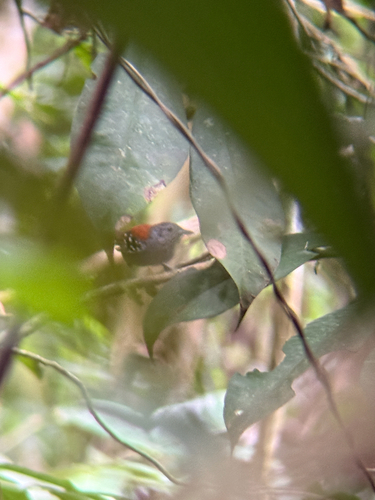
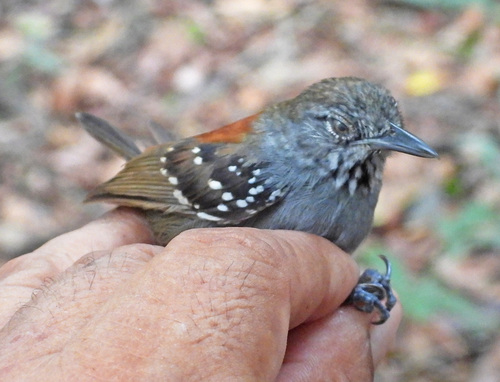
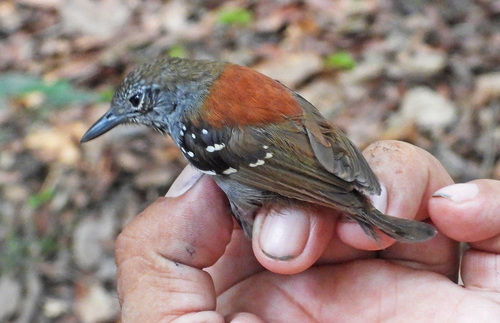
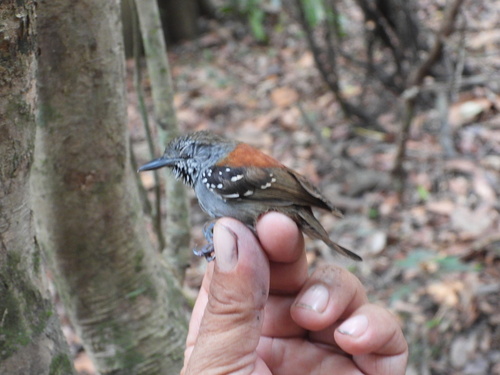
What the Rufous-backed Stipplethroat sounds like


ID tip
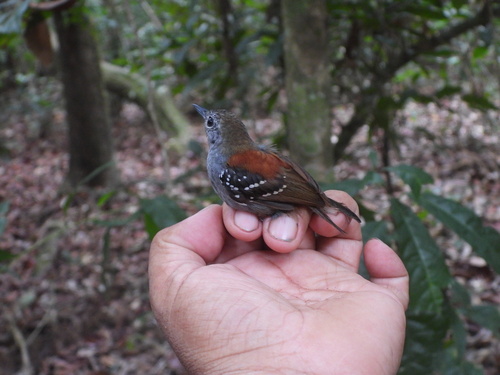
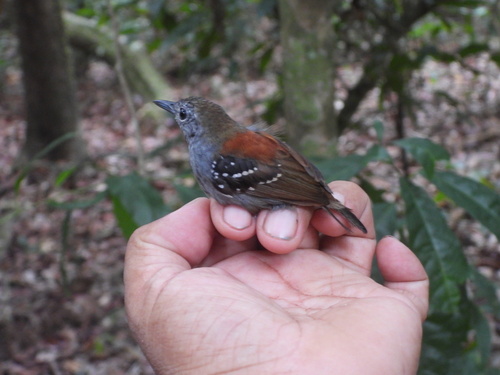
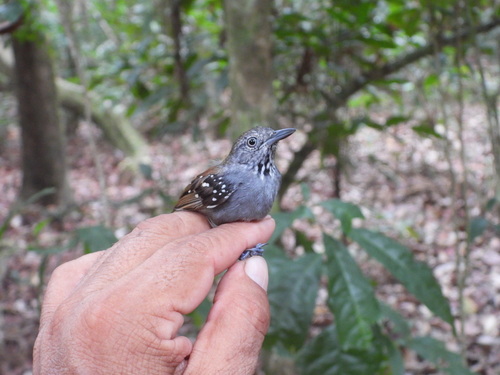
The rufous-backed stipplethroat is 10 to 11 cm (3.9 to 4.3 in) long and weighs 8 to 10.5 g (0.28 to 0.37 oz). Adult males of the nominate subspecies E. h. haematonota have a mostly light gray face and a black throat with white spots. They have a grayish olive-brown crown and mantle, and deep rufous back, tail, and flight feathers. Their wing coverts are blackish brown with pale buff or white tips. Their breast and upper belly are light gray and their lower belly, flanks, and undertail coverts yellow-brown. Adult females have a mostly light yellowish olive-brown face and underparts. Voice: The rufous-backed stipplethroat's song is an "extr. high, very thin, descending, rapid shiver 'tsititi---' " that lasts two or three seconds. Its calls include a "doublet of abrupt notes, second higher-pitched", an "abrupt single note", and a "high-pitched rattle".
Text from Wikipedia, licensed CC BY-SA 4.0.
When to see the Rufous-backed Stipplethroat
One bar for each month. Filled bars are the 11 months with records; pale bars are months with none. The wide bar is July, the month with the most records.
Where to see the Rufous-backed Stipplethroat
The map shades 6 countries with regular records, and 1 more in a lighter tone where the bird turns up only as a stray. Everything unshaded has no records. Countries are listed below the map.
Recorded as a rare visitor in French Guiana.
About the Rufous-backed Stipplethroat
The rufous-backed stipplethroat is a species of bird in subfamily Thamnophilinae of family Thamnophilidae, the "typical antbirds". It is found in Brazil, Colombia, Ecuador, Peru, and Venezuela. In its complex taxonomic history, Epinecrophylla haematonota has also been called the rufous-backed antwren, stipple-throated antwren, Napo stipple-throated antwren, and western stipple-throated antwren.
Text adapted from Wikipedia, licensed CC BY-SA 4.0.
Easily confused with
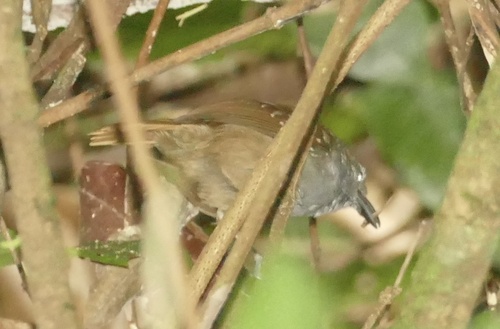 Brown-bellied StipplethroatEpinecrophylla gutturalisThe brown-bellied stipplethroat is 9.5 to 10.5 cm (3.7 to 4.1 in) long and weighs 7.5 to 9.5 g (0.26 to 0.34 oz).
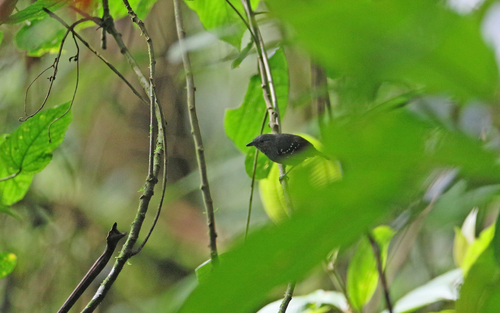 Foothill StipplethroatEpinecrophylla spodionotaThe foothill stipplethroat is 10 to 11 cm (3.9 to 4.3 in) long and weighs 9 to 10.5 g (0.32 to 0.37 oz).
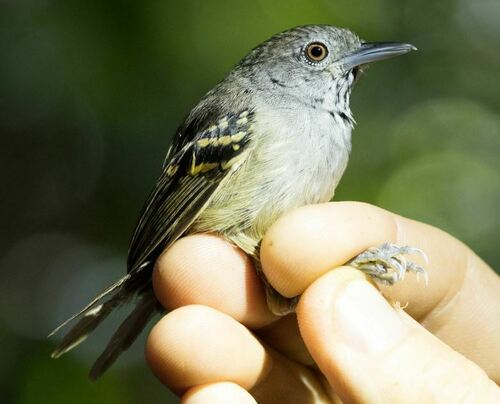 White-eyed StipplethroatEpinecrophylla leucophthalmaThe white-eyed stipplethroat is 9.5 to 11 cm (3.7 to 4.3 in) long and weighs 8 to 10.5 g (0.28 to 0.37 oz).
Learn the Rufous-backed Stipplethroat in the BeakBrain App
Photo and call practice. Coming soon to iPhone and Android.
Play today's Daily BirdEvery photo and recording on this page is credited to its author under the licence shown. Spotted a problem with this page, or have a better photo? Contribute.