Learn what every symbol on the card means.Full credits and sources at beakbrain.com/symbols
 ForestLarge · 502 g
ID tip
To compare, the Male Rufescent Imperial Pigeon is about 41 to 42 centimeters or about 16 to 17 inches in length. In contrast, females are smaller, about 37 to 39 centimeters or 15 inches long, and can be distinguished by slight color differences. Both weigh around 21-22 ounces. Rufescent Imperial Pigeons, both male and female, are larger than most of the other pigeon species. In the subspecies smaragdina, the head is slaty-grey. The back and wing coverts are metallic green, with bronzy and bluish reflections, and the flight feathers are darker and more bluish.
Text from Wikipedia, licensed CC BY-SA 4.0.
When to see the Rufescent Imperial Pigeon
One bar for each month. Filled bars are the 6 months with records; pale bars are months with none. The wide bar is September, the month with the most records.
Where to see the Rufescent Imperial Pigeon
The map shades 2 countries with regular records. Everything unshaded has no records. Countries are listed below the map.
About the Rufescent Imperial Pigeon
The Rufescent Imperial Pigeon, also known as the Shining Imperial Pigeon, is a rare species in the world of birds. According to The International Union for Conservative, this species is relatively unknown, and their concern is very minimal. The Union describes that this species is very stable and does not encounter threats from other species The trait of stability is vital in differentiating The Rufescent Imperial Pigeon from the other species confronting threats. This bird in specific does not frequently encounter threats because they are more reserved, quiet birds that tend to remain alone in their habitat.
Text adapted from Wikipedia, licensed CC BY-SA 4.0.
Easily confused with
 Grey-headed Imperial PigeonDucula radiataThe grey-headed imperial pigeon is a moderate-sized imperial pigeon with a long tail and a total length of about 38 cm (15 in).
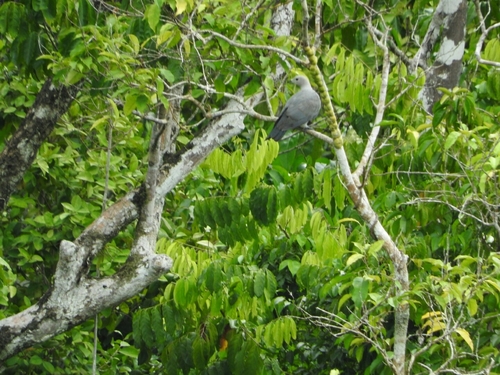 Grey Imperial PigeonDucula pickeringiiThe grey imperial pigeon is a species of bird in the family Columbidae.
 Yellowish Imperial PigeonDucula subflavescensThe yellowish imperial pigeon, also known as the yellow-tinted imperial pigeon or Bismarck imperial pigeon, is a relatively large species of bird in the family Columbidae.
Learn the Rufescent Imperial Pigeon in the BeakBrain App
Photo and call practice. Coming soon to iPhone and Android.
Play today's Daily BirdEvery photo and recording on this page is credited to its author under the licence shown. Spotted a problem with this page, or have a better photo? Contribute.