Learn what every symbol on the card means.Full credits and sources at beakbrain.com/symbols
 GrasslandPlatform nestHuge · 2.1 kg


ID tip
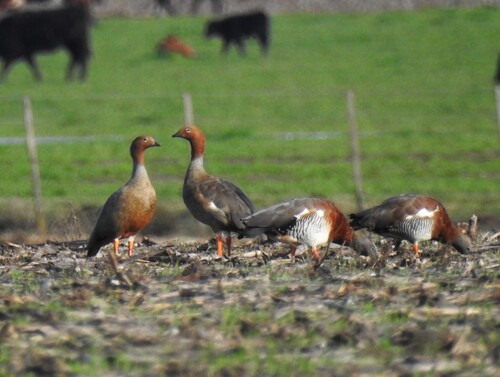
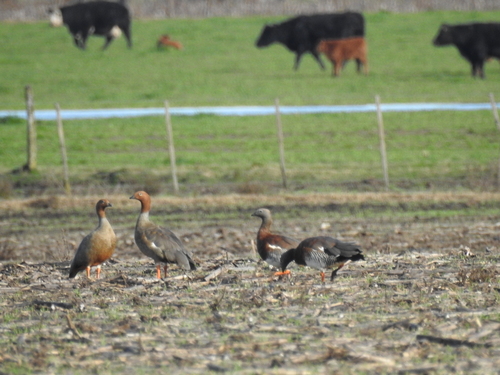
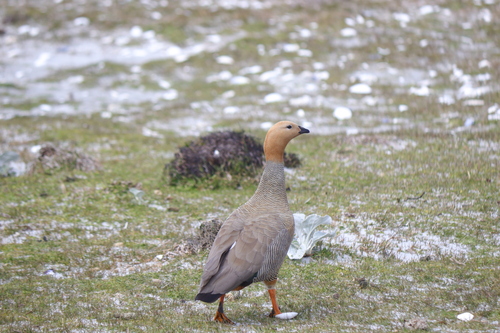
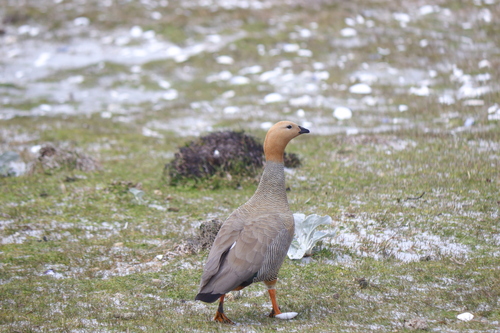
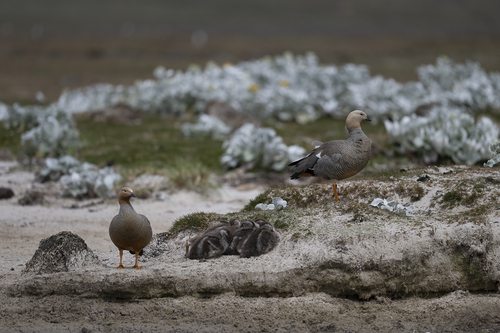
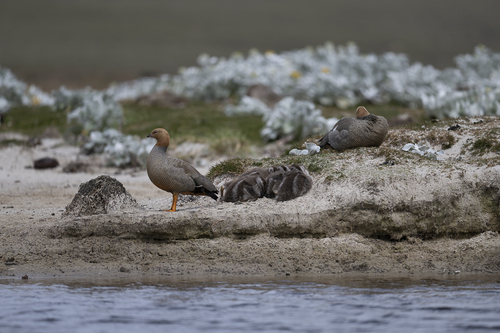
The ruddy-headed goose is 45 to 52.5 cm (18 to 21 in) long. Males weigh 1.65 to 2.02 kg (3.6 to 4.5 lb) and females 1.20 to 1.50 kg (2.6 to 3.3 lb). Adults have the same plumage. Their heads and necks are red-brown, their back, breast, and flanks gray and buff with brown barring, their belly cinnamon, and their tail black. Their wing's upperside is gray and the underside gray, black, and white. Their bill is black and the legs and feet orange with black markings. Juveniles are similar to adults but duller overall. Voice: Male and female ruddy-headed geese have different vocalizations: Males make a "short, whistled 'seep'" and females a "short rasping quack".
Text from Wikipedia, licensed CC BY-SA 4.0.
When to see the Ruddy-headed Goose
One bar for each month. Filled bars are the 8 months with records; pale bars are months with none. The wide bar is November, the month with the most records.
Where to see the Ruddy-headed Goose
The map shades 3 countries with regular records, and 1 more in a lighter tone where the bird turns up only as a stray. Everything unshaded has no records. Countries are listed below the map.
Recorded as a rare visitor in Germany.
About the Ruddy-headed Goose
The ruddy-headed goose is a species of waterfowl in tribe Tadornini of subfamily Anserinae. It is found in Argentina, Chile, and the Falkland Islands.
Text adapted from Wikipedia, licensed CC BY-SA 4.0.
Easily confused with
 Kelp GooseChloephaga hybridaThe kelp goose is 55 to 65 cm (22 to 26 in) long.
 Ashy-headed GooseChloephaga poliocephalaThe ashy-headed goose is 50 to 60 cm (20 to 24 in) long.
 Andean GooseChloephaga melanopteraThe Andean goose is 70 to 76 cm (28 to 30 in) long and weighs 2.73 and 3.64 kg (6.0 and 8.0 lb).
Side by side: Andean Goose vs Ruddy-headed Goose · Ashy-headed Goose vs Ruddy-headed Goose · Kelp Goose vs Ruddy-headed Goose
Learn the Ruddy-headed Goose in the BeakBrain App
Photo and call practice. Coming soon to iPhone and Android.
Play today's Daily BirdEvery photo and recording on this page is credited to its author under the licence shown. Spotted a problem with this page, or have a better photo? Contribute.