Learn what every symbol on the card means.Full credits and sources at beakbrain.com/symbols
 ForestTiny · 14 g
What the Roraiman Flycatcher sounds like


ID tip
The Roraiman flycatcher is 13.5 to 14 cm (5.3 to 5.5 in) long and weighs 12.8 to 13.6 g (0.45 to 0.48 oz). The sexes have almost identical plumage. Adult males of the nominate subspecies have an olive-tinged warm rufescent brown crown with a mostly hidden orange-rufous patch in the middle. Females do not have this patch. Both sexes have an inconspicuous yellowish white broken eye-ring on an otherwise olive brown face. Their back and rump are olive-brown. Voice: What may be either the song or a call of the Roraiman flycatcher in Ecuador is "an explosive and buzzy series of sputtered 'tschew' notes, rising and then descending" that has been written as "TSEW! TSI pit-pit TSI'TSI'tsi-tew". It also makes "softer sharp 'pit' or 'tschit' " notes that can be doubled or become a trill.
Text from Wikipedia, licensed CC BY-SA 4.0.
When to see the Roraiman Flycatcher
One bar for each month. Filled bars are the 11 months with records; pale bars are months with none. The wide bar is February, the month with the most records.
Where to see the Roraiman Flycatcher
The map shades 4 countries with regular records, and 1 more in a lighter tone where the bird turns up only as a stray. Everything unshaded has no records. Countries are listed below the map.
Recorded as a rare visitor in Brazil.
About the Roraiman Flycatcher
The Roraiman flycatcher is a species of bird in the family Tyrannidae, the tyrant flycatchers. It is found in Brazil, Colombia, Ecuador, Guyana, Peru, Venezuela, and possibly in Bolivia.
Text adapted from Wikipedia, licensed CC BY-SA 4.0.
Easily confused with
 Unadorned FlycatcherMyiophobus inornatusThe unadorned flycatcher is about 11.5 cm (4.5 in) long and weighs about 9 to 12 g (0.32 to 0.42 oz).
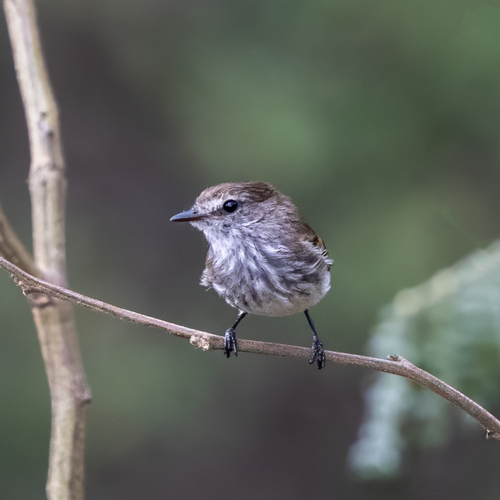 Mouse-grey FlycatcherMyiophobus crypterythrusThe mouse-gray flycatcher is 12 to 12.5 cm (4.7 to 4.9 in) long.
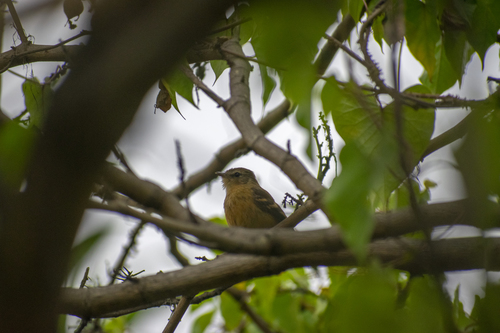 Rufescent FlycatcherMyiophobus rufescensThe rufescent flycatcher is 11.5 to 12.5 cm (4.5 to 4.9 in) long.
Learn the Roraiman Flycatcher in the BeakBrain App
Photo and call practice. Coming soon to iPhone and Android.
Play today's Daily BirdEvery photo and recording on this page is credited to its author under the licence shown. Spotted a problem with this page, or have a better photo? Contribute.