Learn what every symbol on the card means.Full credits and sources at beakbrain.com/symbols
 WoodlandCavity nestSmall · 53 g


What the Rock Parrot sounds like


ID tip
Ranging from 22 to 24 cm (8+3⁄4 to 9+1⁄2 in) long with a 33–34 cm (13–13+1⁄2 in) wingspan, the rock parrot is a small and slightly built parrot weighing around 50–60 g (1+3⁄4–2 oz). The sexes are similar in appearance, with predominantly olive-brown upperparts including the head and neck, and more yellowish underparts. A dark blue band runs across the upper forehead between the eyes, bordered above by a thin light blue line that extends behind the eyes and below by a thicker light blue band across the lower forehead. The forecheeks and lores are light blue.
Text from Wikipedia, licensed CC BY-SA 4.0.
When to see the Rock Parrot
One bar for each month. Filled bars are the 11 months with records; pale bars are months with none. The wide bar is March, the month with the most records.
Where to see the Rock Parrot
The map shades 1 country with regular records. Everything unshaded has no records. Countries are listed below the map.
About the Rock Parrot
The rock parrot is a species of grass parrot native to Australia. Described by John Gould in 1841, it is a small parrot 22–24 cm long and weighing 50–60 g with predominantly olive-brown upperparts and more yellowish underparts. Its head is olive with light blue forecheeks and lores, and a dark blue frontal band line across the crown with lighter blue above and below. The sexes are similar in appearance, although the female tends to have a duller frontal band and less blue on the face. The female's call also tends to be far louder and more shrill than the male's. Two subspecies are currently recognised.
Text adapted from Wikipedia, licensed CC BY-SA 4.0.
Easily confused with
 Orange-bellied ParrotNeophema chrysogasterThe orange-bellied parrot is a small parrot around 20 cm (8 in) long; the adult male has bright green head, neck and upperparts, and yellow-green breast, abdomen and flanks.
 Scarlet-chested ParrotNeophema splendidaMeasuring 19–21 cm (8 in) in length, this small vibrant and brightly coloured parrot is sexually dimorphic.
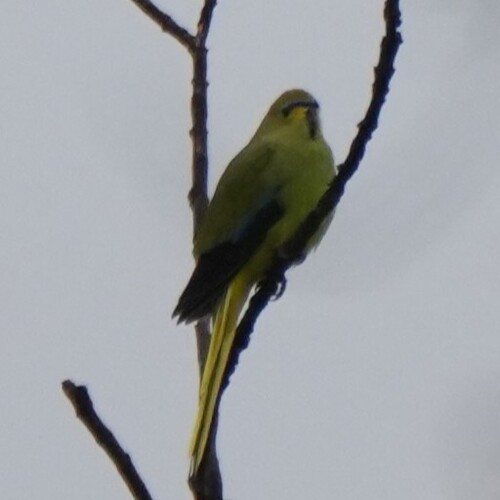 Elegant ParrotNeophema elegansThe elegant parrot is 23 cm (9.1 in) long and predominantly golden olive in colour with a dark blue frontal band line above with lighter blue, while abdomen and vent are yellow.
Learn the Rock Parrot in the BeakBrain App
Photo and call practice. Coming soon to iPhone and Android.
Play today's Daily BirdEvery photo and recording on this page is credited to its author under the licence shown. Spotted a problem with this page, or have a better photo? Contribute.