Learn what every symbol on the card means.Full credits and sources at beakbrain.com/symbols
 RockyDomed nestTiny · 11 g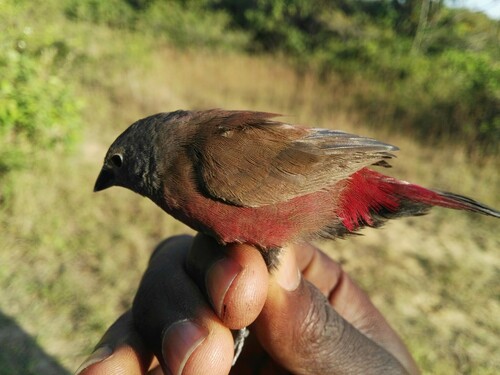


ID tip
Rock firefinches are sexually dimorphic, where adult males have more brightly colored plumage than adult females. Males are characterized by a bright red back and a deep red face, throat, breast, and belly. Females are characterized by a reddish-brown back, brownish-gray face, and a greyish-red throat, breast, and belly. A bluish-grey bill is one of the most important defining traits of all rock firefinches. Both males and females have a brownish-grey crown, brownish-red upper wing coverts, deep red rump and upper tail coverts, and white-spotted dark grey flanks and under wing coverts.
Text from Wikipedia, licensed CC BY-SA 4.0.
When to see the Rock Firefinch
One bar for each month. Filled bars are the 11 months with records; pale bars are months with none. The wide bar is December, the month with the most records.
Where to see the Rock Firefinch
The map shades 2 countries with regular records. Everything unshaded has no records. Countries are listed below the map.
About the Rock Firefinch
The rock firefinch is a species of estrildid finch found in the Jos Plateau of central Nigeria and in Cameroon. It has an estimated global extent of occurrence of 29,000 km2 (11,000 sq mi). The rock firefinch was discovered recently, in 1998. Rock firefinches fall in the family Estrildidae, which contains small passerine birds of the Old World and Australasia. Rock firefinches seem to be most closely related to Mali firefinches and Chad firefinches. The species name sanguinodorsalis means blood-red back, which was chosen because it describes the vibrant red back color of the male plumage. The status of the species is evaluated as Least Concern.
Text adapted from Wikipedia, licensed CC BY-SA 4.0.
Easily confused with
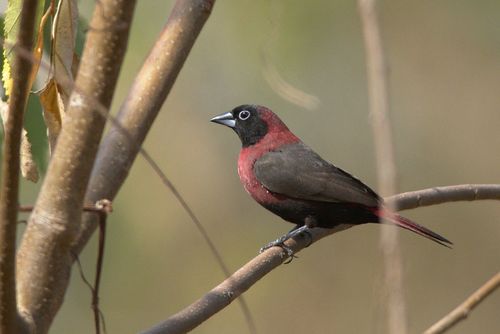 Black-faced FirefinchLagonosticta larvataThe black-faced firefinch is a common species of estrildid finch found in Africa.
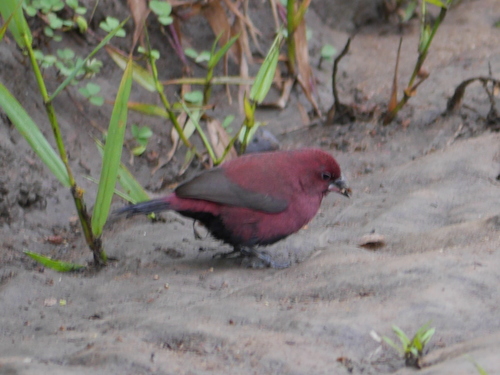 Black-bellied FirefinchLagonosticta raraThe black-bellied firefinch is a common species of estrildid finch found in Africa.
Mali FirefinchLagonosticta virataThe Mali firefinch is a species of estrildid finch found in Western Africa.
Black-bellied FirefinchLagonosticta raraThe black-bellied firefinch is a common species of estrildid finch found in Africa.
Mali FirefinchLagonosticta virataThe Mali firefinch is a species of estrildid finch found in Western Africa.
Learn the Rock Firefinch in the BeakBrain App
Photo and call practice. Coming soon to iPhone and Android.
Play today's Daily BirdEvery photo and recording on this page is credited to its author under the licence shown. Spotted a problem with this page, or have a better photo? Contribute.