Learn what every symbol on the card means.Full credits and sources at beakbrain.com/symbols
 ForestCavity nestHuge · 2.4 kg


What the Rhinoceros Hornbill sounds like

ID tip
The rhinoceros hornbill is a large arboreal hornbill, 80 to 90 cm (31–35 in) long. The weight varies by sex, with males weighing around 2,465 to 2,960 g (87.0–104.4 oz) and the females 2,040 to 2,330 g (72–82 oz). The plumage is predominantly black, with white legs and vent and a white tail with a black band. The huge bill and casque are orange and red, the colour coming from preen oil rubbed on from the preen gland above the tail. The eyes of the male are red with black rims, and white with red rims in the female.
Text from Wikipedia, licensed CC BY-SA 4.0.
When to see the Rhinoceros Hornbill
One bar for each month. Filled bars are the 10 months with records; pale bars are months with none. The wide bar is July, the month with the most records.
Where to see the Rhinoceros Hornbill
The map shades 5 countries with regular records. Everything unshaded has no records. Countries are listed below the map.
About the Rhinoceros Hornbill
The rhinoceros hornbill is a large species of forest hornbill (Bucerotidae). In captivity it can live for up to 35 years. It is found in lowland and montane, tropical and subtropical climates and in mountain rain forests up to 1,400 metres in Borneo, Sumatra, Java, the Malay Peninsula, Singapore, and southern Thailand.
Text adapted from Wikipedia, licensed CC BY-SA 4.0.
Easily confused with
 Great HornbillBuceros bicornisThe great hornbill is a large bird, 95–130 cm (37–51 in) long, with a 152 cm (60 in) wingspan and a weight of 2 to 4 kg (4.4 to 8.8 lb).
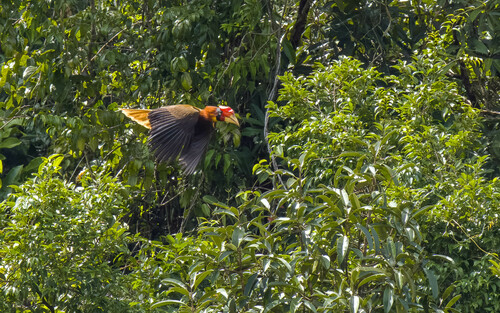 Rufous HornbillBuceros hydrocoraxThe rufous hornbill, also known as the Philippine hornbill and locally as kalaw, is a large species of hornbill endemic to the Philippines.
Side by side: Great Hornbill vs Rhinoceros Hornbill
Learn the Rhinoceros Hornbill in the BeakBrain App
Photo and call practice. Coming soon to iPhone and Android.
Play today's Daily BirdEvery photo and recording on this page is credited to its author under the licence shown. Spotted a problem with this page, or have a better photo? Contribute.