Learn what every symbol on the card means.Full credits and sources at beakbrain.com/symbols
 ShrublandCavity nestTiny · 13 g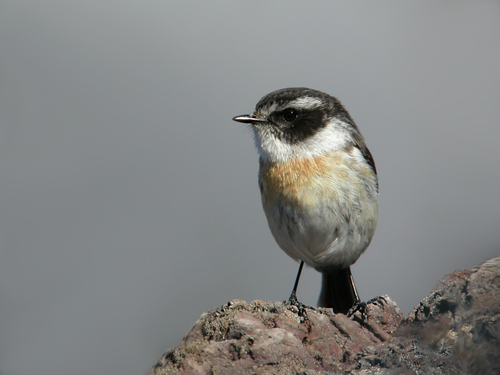


What the Reunion Stonechat sounds like

ID tip
Overall, the male is black above and white below, but also with a white supercilium (sometimes absent), half-collar, and greater covert patch, and a variable-sized orange patch on the breast. Females differ from males in being browner above, more buff-toned below, and often lacking the white greater covert patch. The white throat and (usually white) supercilium are the most prominent external differences from the African stonechat S. torquatus, which has a wholly black head including the throat and supercilium.
Text from Wikipedia, licensed CC BY-SA 4.0.
When to see the Reunion Stonechat
One bar for each month. Filled bars are the 8 months with records; pale bars are months with none. The wide bar is October, the month with the most records.
Where to see the Reunion Stonechat
The map shades 1 country with regular records. Everything unshaded has no records. Countries are listed below the map.
About the Reunion Stonechat
The Réunion stonechat is a species of stonechat, endemic to the French Indian Ocean island of Réunion. It is found across the island in forests, shrublands and artificial environments such as gardens and plantations. This small passerine bird is common in clearings and open mountain bushlands there up to 2600 metres above sea level, including in the plains around Piton de la Fournaise.
Text adapted from Wikipedia, licensed CC BY-SA 4.0.
Easily confused with
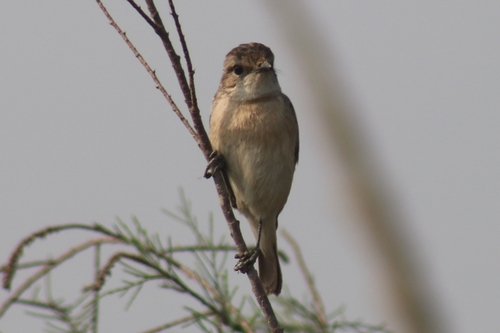 White-tailed StonechatSaxicola leucurusVery similar in plumage to european stonechat (Saxicola rubicola).
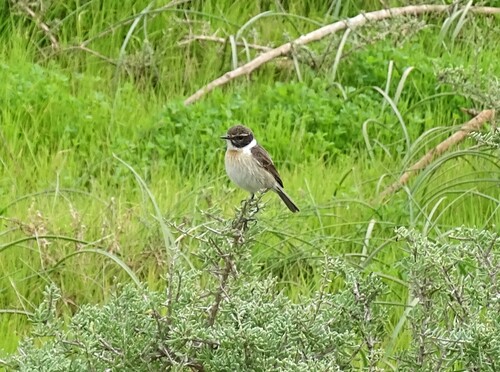 Canary Islands StonechatSaxicola dacotiaeThe Canary Islands stonechat is intermediate in appearance between the European stonechat and the whinchat; its body size and shape reminiscent of a lithe European robin.
 White-browed Bush ChatSaxicola macrorhynchusThe white-browed bush chat, also known as Stoliczka's bushchat, is an Old World flycatcher in the genus Saxicola.
Side by side: Reunion Stonechat vs Siberian Stonechat
Learn the Reunion Stonechat in the BeakBrain App
Photo and call practice. Coming soon to iPhone and Android.
Play today's Daily BirdEvery photo and recording on this page is credited to its author under the licence shown. Spotted a problem with this page, or have a better photo? Contribute.