Learn what every symbol on the card means.Full credits and sources at beakbrain.com/symbols
 MarinePlatform nestLarge · 377 g


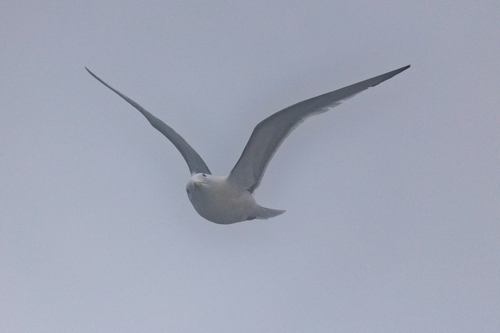


ID tip
The red-legged kittiwake is a very localised subarctic Pacific species. Apart from the distinguishing feature implicit in its name, it is very similar to its better-known relative, the black-legged kittiwake; other differences include the shorter bill, larger eyes, a larger, rounder head, and darker gray wings, and in the juveniles, which barely differ from the adults, lacking the black tail band and "W" across the wings of juvenile black-legged kittiwakes. Juveniles take three years to reach maturity.
Text from Wikipedia, licensed CC BY-SA 4.0.
When to see the Red-legged Kittiwake
One bar for each month. Filled bars are the 5 months with records; pale bars are months with none. The wide bar is June, the month with the most records.
Where to see the Red-legged Kittiwake
The map shades 3 countries with regular records, and 1 more in a lighter tone where the bird turns up only as a stray. Everything unshaded has no records. Countries are listed below the map.
Recorded as a rare visitor in Canada.
About the Red-legged Kittiwake
The red-legged kittiwake is a seabird species in the gull family Laridae. It breeds in the Pribilof Islands, Bogoslof Island, and Buldir Island in the Bering Sea off the coast of Alaska, and the Commander Islands, Russia, and spends the winter at sea.
Text adapted from Wikipedia, licensed CC BY-SA 4.0.
Easily confused with

Side by side: Black-legged Kittiwake vs Red-legged Kittiwake
Learn the Red-legged Kittiwake in the BeakBrain App
Photo and call practice. Coming soon to iPhone and Android.
Play today's Daily BirdEvery photo and recording on this page is credited to its author under the licence shown. Spotted a problem with this page, or have a better photo? Contribute.