Learn what every symbol on the card means.Full credits and sources at beakbrain.com/symbols
 ShrublandDomed nestTiny · 10 g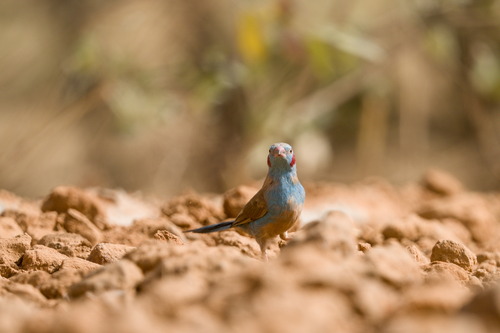


What the Red-cheeked Cordon-bleu sounds like

ID tip
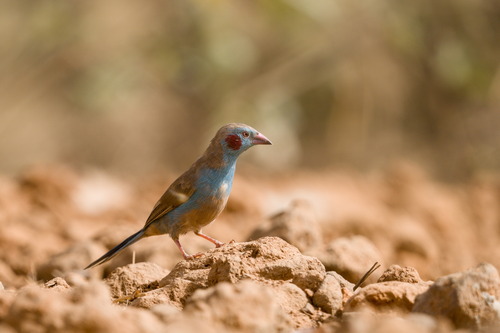
Like other members of its genus, the red-cheeked cordon-bleu is a very small finch, measuring only 12.5–13 cm (4.9–5.1 in) in length. It weighs 9.9 g (0.35 oz) on average, with known extremes in wild populations ranging from 8.9–11 g (0.31–0.39 oz). The adult male has uniformly brown upperparts, pale blue breast, flanks and tail and a yellow belly. There is a red patch on each cheek, but this can rarely appear orange or even yellow. Females are similar but duller, and lack the cheek spot. Immature birds are like the female, but with blue restricted to the face and throat. Voice: Its contact call is a thin, high-pitched piping, often repeated, and variously transcribed as siii siii or tsee tsee. The song is more complex, consisting of 4–6 high-pitched notes, the last of which is longer, lower and more burry. Described as "rhythmic but lazy", it has been transcribed as wit-sit-diddley-diddley-ee-ee.
Text from Wikipedia, licensed CC BY-SA 4.0.
When to see the Red-cheeked Cordon-bleu
One bar for each month, and every month is filled: this bird is recorded here in all twelve. The wide bar is November, the month with the most records.
Where to see the Red-cheeked Cordon-bleu
The map shades 30 countries with regular records, and 5 more in a lighter tone where the bird turns up only as a stray. Everything unshaded has no records. Countries are listed below the map.
Recorded as a rare visitor in United States, Spain, Canada, Puerto Rico, Martinique.
About the Red-cheeked Cordon-bleu
The red-cheeked cordon-bleu or red-cheeked cordonbleu is a small passerine bird in the family Estrildidae. This estrildid finch is a resident breeding bird in drier regions of tropical Sub-Saharan Africa. Red-cheeked cordon-bleu has an estimated global extent of occurrence of 7,700,000 km2.
Text adapted from Wikipedia, licensed CC BY-SA 4.0.
Easily confused with
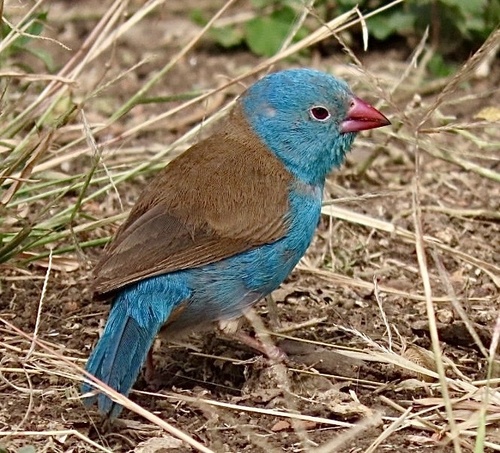 Blue-capped Cordon-bleuUraeginthus cyanocephalusThe blue-capped cordon-bleu or blue-capped cordonbleu is native to Ethiopia, Kenya, Somalia, South Sudan, and Tanzania in East Africa.
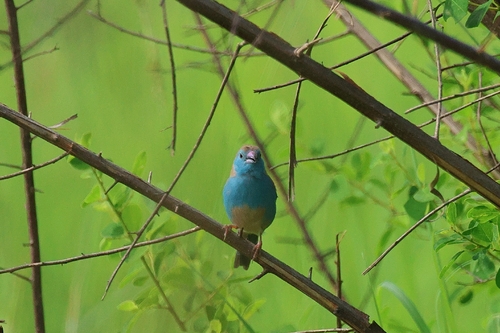 Blue WaxbillUraeginthus angolensisThe blue waxbill has powder-blue face, breast, rump, and flanks with pale brown upperparts.
Side by side: Blue Waxbill vs Red-cheeked Cordon-bleu
Learn the Red-cheeked Cordon-bleu in the BeakBrain App
Photo and call practice. Coming soon to iPhone and Android.
Play today's Daily BirdEvery photo and recording on this page is credited to its author under the licence shown. Spotted a problem with this page, or have a better photo? Contribute.