Learn what every symbol on the card means.Full credits and sources at beakbrain.com/symbols
 ForestCavity nestMedium · 116 g




ID tip
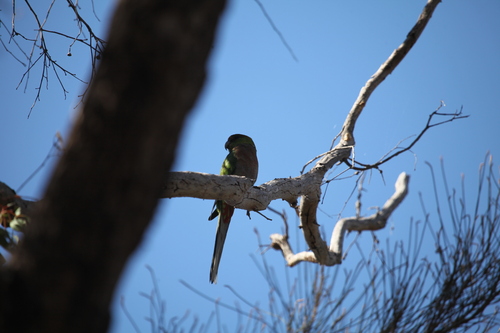
The red-capped parrot has a long bill and bright, clear patterned plumage, variously described as magnificent, gaudy, or clownishly coloured. Measuring 34–38 cm (13.5–15 in) in length with a 42–48 cm (16.5–19 in) wingspan, and weighing 105–125 g (3.7–4.4 oz), an adult red-capped parrot is a distinctive and easily recognised medium-sized parrot. The adult male has a crimson forehead and crown, which extends from the gape or base of the lower mandible through the eye and grey-brown lores. Its hindneck and cheeks are green, and its ear coverts are more yellow-green.
Text from Wikipedia, licensed CC BY-SA 4.0.
When to see the Red-capped Parrot
One bar for each month, and every month is filled: this bird is recorded here in all twelve. The wide bar is October, the month with the most records.
Where to see the Red-capped Parrot
The map shades 1 country with regular records. Everything unshaded has no records. Countries are listed below the map.
About the Red-capped Parrot
The red-capped parrot is a species of broad-tailed parrot native to southwestern Australia. It was described by Heinrich Kuhl in 1820, with no subspecies recognised. It has long been classified in its own genus owing to its distinctive elongated beak, though genetic analysis shows that it lies within the lineage of the Psephotellus parrots and that its closest relative is the mulga parrot. Not easily confused with other parrot species, it has a bright crimson crown, green-yellow cheeks, and a distinctive long bill. The wings, back, and long tail are dark green, and the underparts are purple-blue.
Text adapted from Wikipedia, licensed CC BY-SA 4.0.
Easily confused with
 Blue-winged ParrotNeophema chrysostomaRanging from 20 to 24 cm long and weighing around 55 g, the parrot is sexually dimorphic—both sexes are predominantly olive-green.
 Red-crowned ParakeetCyanoramphus novaezelandiaeVoice: Red-crowned parakeets can be recognised by their soft, musical, chattering calls.
 Swift ParrotLathamus discolorThe swift parrot is about 25 centimetres (10 in) long and has long pointed wings and long tapering tail feathers.
Side by side: Blue-winged Parrot vs Red-capped Parrot · Red-capped Parrot vs Red-crowned Parakeet · Red-capped Parrot vs Swift Parrot
Learn the Red-capped Parrot in the BeakBrain App
Photo and call practice. Coming soon to iPhone and Android.
Play today's Daily BirdEvery photo and recording on this page is credited to its author under the licence shown. Spotted a problem with this page, or have a better photo? Contribute.