Learn what every symbol on the card means.Full credits and sources at beakbrain.com/symbols
 ForestCavity nestMedium · 123 g
ID tip
Adults have a fierce-looking face. The body overall is dark brown. When perched, the blackish crown and white ear-tufts are visible. Its underparts are brownish with thick black streaking. It has a distinct orange iris. The subspecies Otus brookii solokensis is different in plumage from O. b. brookii in having darker underparts, thicker streaking a less distinct nuchal collar. Juveniles of O. b. brookii remain undescribed. O. b.solokensis has rufous upperparts and vermiculations on the underparts. Voice: O.b.solokensis has an explosive "owh" or "owh-owh" barking call lasting about a half-second and repeated irregularly.
Text from Wikipedia, licensed CC BY-SA 4.0.
When to see the Rajah Scops Owl
One bar for each month. Filled bars are the 7 months with records; pale bars are months with none. The wide bar is July, the month with the most records.
Where to see the Rajah Scops Owl
The map shades 1 country with regular records. Everything unshaded has no records. Countries are listed below the map.
About the Rajah Scops Owl
The Rajah scops owl is a species of owl found on the islands of Borneo and Sumatra. The bird is named after James Brooke, Rajah of Sarawak. Based on patterns of speciation in other endemic montane bird species of the same region, it may potentially have to be split into two distinct species; if so, the name Otus brookii would be restricted to just the Bornean population.
Text adapted from Wikipedia, licensed CC BY-SA 4.0.
Easily confused with
 Pemba Scops OwlOtus pembaensisThe Pemba scops owl is a medium-sized scops-owl with short ear-tufts.
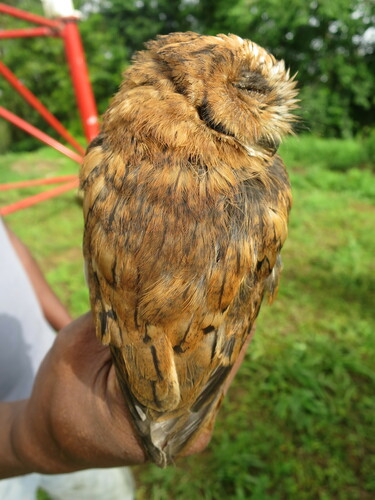 Sao Tome Scops OwlOtus hartlaubiThe São Tomé scops owl is a small, secretive owl with small ear-tufts.
Biak Scops OwlOtus beccariiThe Biak scops owl is a species of owl endemic to the twin islands of Biak-Supiori in Cenderawasih Bay, Papua, Indonesia.
Sao Tome Scops OwlOtus hartlaubiThe São Tomé scops owl is a small, secretive owl with small ear-tufts.
Biak Scops OwlOtus beccariiThe Biak scops owl is a species of owl endemic to the twin islands of Biak-Supiori in Cenderawasih Bay, Papua, Indonesia.
Learn the Rajah Scops Owl in the BeakBrain App
Photo and call practice. Coming soon to iPhone and Android.
Play today's Daily BirdEvery photo and recording on this page is credited to its author under the licence shown. Spotted a problem with this page, or have a better photo? Contribute.