Learn what every symbol on the card means.Full credits and sources at beakbrain.com/symbols
 ForestCup nestMedium · 101 g
ID tip
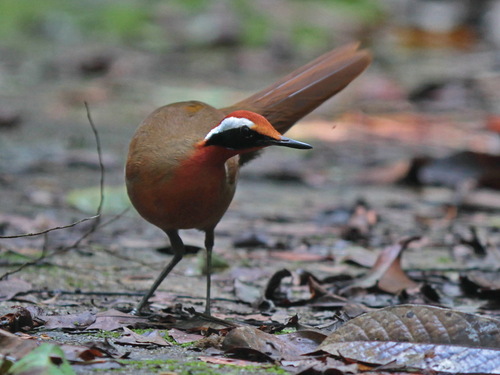
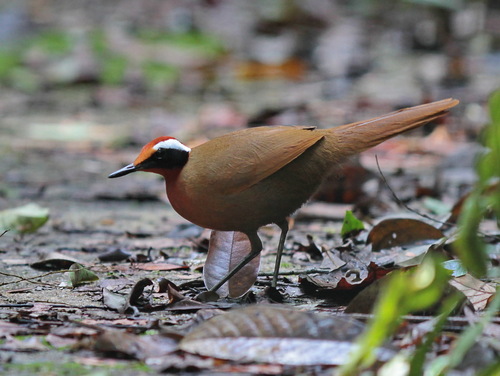
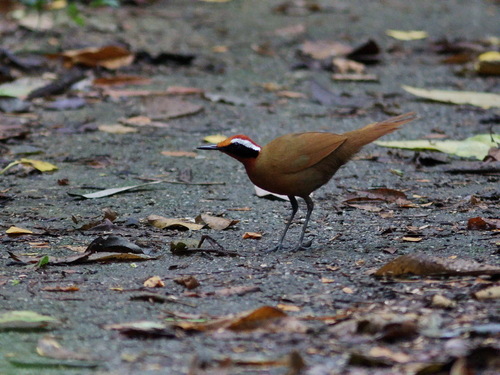
It is a medium-sized, fairly slender songbird, about 28 to 30 cm (11–12 in) in length, and weighing 66 to 72 g (2.3–2.5 oz). It has a long thin neck, long black bill, long legs and a long tail. The plumage is mainly brown with a more reddish forehead and crown, and the foreneck, chin and throat are a rich chestnut. It has a long, black eyestripe extending from the bill to the side of the neck and a broad, white supercilium above it.
Text from Wikipedia, licensed CC BY-SA 4.0.
When to see the Rail-babbler
One bar for each month. Filled bars are the 9 months with records; pale bars are months with none. The wide bar is July, the month with the most records.
Where to see the Rail-babbler
The map shades 3 countries with regular records. Everything unshaded has no records. Countries are listed below the map.
About the Rail-babbler
The rail-babbler or Malaysian rail-babbler is a brown and pied rail-like ground-living bird. It is the only species in the genus Eupetes and family Eupetidae. It lives on the floor of primary forests in the Malay Peninsula and Sumatra, as well as Borneo. It is distantly related to African rockfowl. Its population has greatly decreased because much of the lowland primary forest has been cut, and secondary forests usually have too dense a bottom vegetation or do not offer enough shade to be favourable for the species. However, it is locally still common in logged forest or on hill-forest on slopes, and probably not in immediate danger of extinction.
Text adapted from Wikipedia, licensed CC BY-SA 4.0.
Learn the Rail-babbler in the BeakBrain App
Photo and call practice. Coming soon to iPhone and Android.
Play today's Daily BirdEvery photo and recording on this page is credited to its author under the licence shown. Spotted a problem with this page, or have a better photo? Contribute.