Learn what every symbol on the card means.Full credits and sources at beakbrain.com/symbols
 ForestCavity nestSmall · 17 g
ID tip
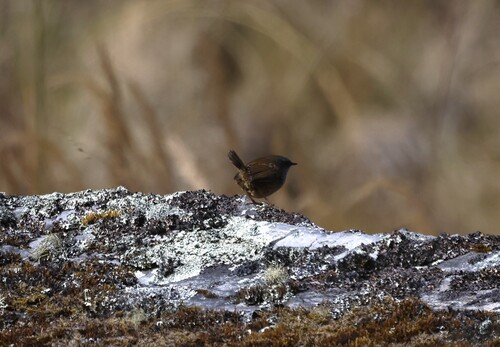
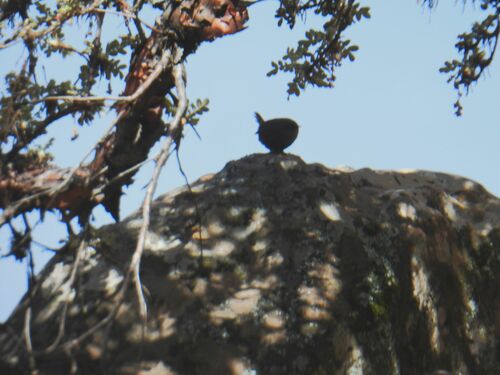
The puna tapaculo is 10 to 12 cm (3.9 to 4.7 in) long. Three males weighed 15.7 to 20 g (0.55 to 0.71 oz) and a female 15.7 g (0.55 oz). The adult male's upper parts are gray, often washed with brown on the neck and back. It has a narrow pale supercilium. The throat and breast are also gray. The rump, flanks, and belly can be cinnamon or olive-buff and have dark bars. The adult female is similar to the males that have the brown wash; otherwise they may be paler. Immatures are paler overall but have a heavier brown wash on the upper parts. The entire underside is barred. Voice: The song of the puna tapaculo was described by D.L. Lane as "a series of descending churred phrases: tcherr tcherr tcherr tcherr ...." . Lane described a call as "a descending whinny: djee-ee-ee-eer" .
Text from Wikipedia, licensed CC BY-SA 4.0.
When to see the Puna Tapaculo
One bar for each month. Filled bars are the 11 months with records; pale bars are months with none. The wide bar is October, the month with the most records.
Where to see the Puna Tapaculo
The map shades 2 countries with regular records. Everything unshaded has no records. Countries are listed below the map.
About the Puna Tapaculo
The puna tapaculo is a species of bird in the family Rhinocryptidae. It is found in Bolivia and Peru.
Text adapted from Wikipedia, licensed CC BY-SA 4.0.
Easily confused with
 Planalto TapaculoScytalopus pachecoiThe Planalto tapaculo is about 12 cm (4.7 in) long and weighs about 15 g (0.53 oz).
Learn the Puna Tapaculo in the BeakBrain App
Photo and call practice. Coming soon to iPhone and Android.
Play today's Daily BirdEvery photo and recording on this page is credited to its author under the licence shown. Spotted a problem with this page, or have a better photo? Contribute.