Learn what every symbol on the card means.Full credits and sources at beakbrain.com/symbols
 ForestCavity nestTiny · 6 g


ID tip
The Puerto Rican tody is a small, brightly colored, non-passerine forest bird. It is one of the smallest representatives of the order Coraciiformes, with an average body length of 11 cm and weight of 5 to 6 g. The upperparts of the Puerto Rican tody are an emerald green color, and it has light-yellow flanks and underside tail coverts, and a white belly and chest. The "San Pedrito", also known as "Medio Peso" by the local people, has a red throat and lower bill, which in itself is long and broad. It can be as long or longer than the head, and as half as long as the wing.
Text from Wikipedia, licensed CC BY-SA 4.0.
When to see the Puerto Rican Tody
One bar for each month. Filled bars are the 10 months with records; pale bars are months with none. The wide bar is January, the month with the most records.
Where to see the Puerto Rican Tody
The map shades 1 country with regular records. Everything unshaded has no records. Countries are listed below the map.
About the Puerto Rican Tody
The Puerto Rican tody, locally known in Spanish as San Pedrito, is a bird endemic to the main island of Puerto Rico. In 2022, the tody was approved as the official national bird of Puerto Rico by the legislative assembly. However, the proposal did not advance, largely due to the scientific name of the bird which erroneously identifies it as a native of Mexico. In 2023, the assembly approved a petition to the International Commission on Zoological Nomenclature (ICZN) seeking the renaming of the tody as Todus borinquensis.
Text adapted from Wikipedia, licensed CC BY-SA 4.0.
Easily confused with
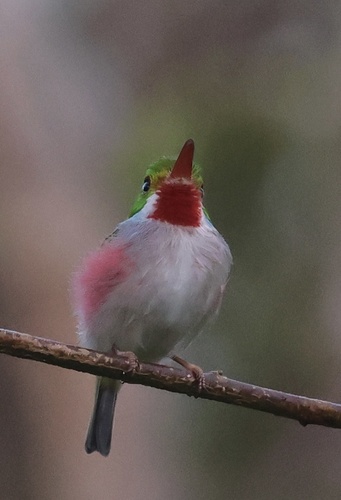 Cuban TodyTodus multicolorThe species is characterized by small size with a length of 11 cm (4.3 in) and weighing 5.9 g (0.21 oz).
 Broad-billed TodyTodus subulatusThe broad-billed tody is a small, rotund bird with a short tail, distinctive bright green feathers on its back, head and wings, as well as a plain white breast tinged with yellow.
 Jamaican TodyTodus todusThe Jamaican tody is a small, chunky bird that averages about 9 cm (or 4.25") in size.
Side by side: Cuban Tody vs Puerto Rican Tody · Broad-billed Tody vs Puerto Rican Tody · Jamaican Tody vs Puerto Rican Tody
Learn the Puerto Rican Tody in the BeakBrain App
Photo and call practice. Coming soon to iPhone and Android.
Play today's Daily BirdEvery photo and recording on this page is credited to its author under the licence shown. Spotted a problem with this page, or have a better photo? Contribute.