Learn what every symbol on the card means.Full credits and sources at beakbrain.com/symbols


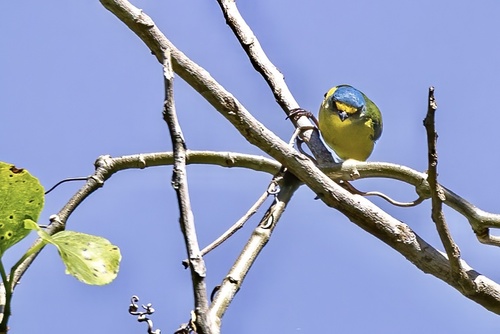
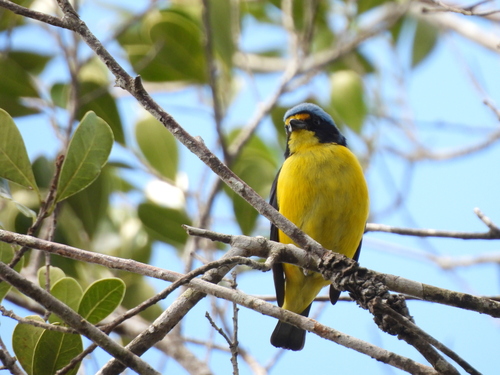
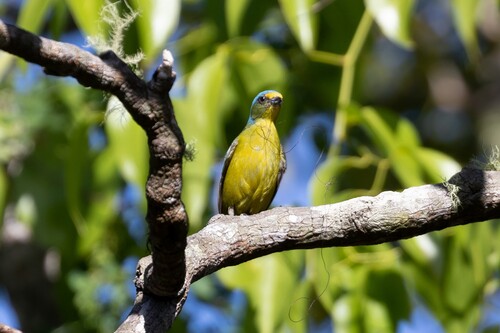
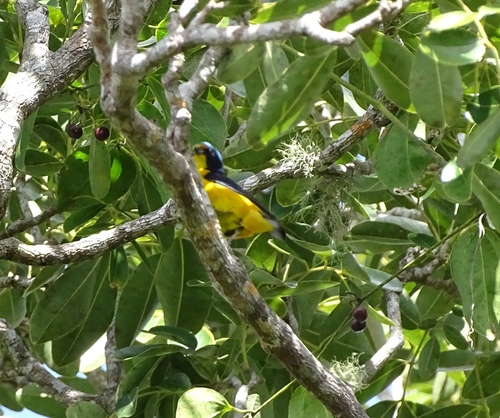
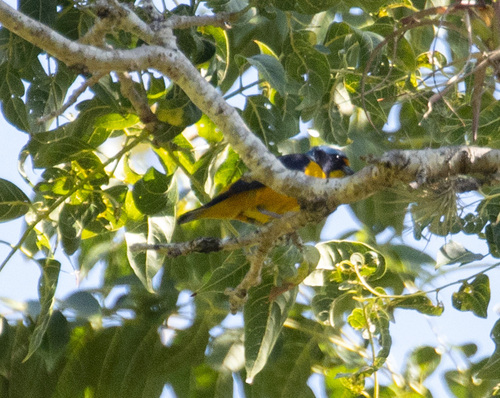
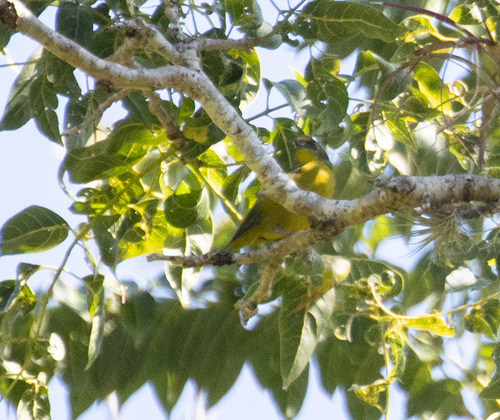
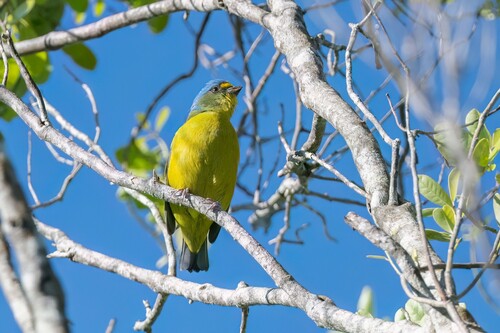
ID tip
The Puerto Rican euphonia is about 10 to 12 cm (3.9 to 4.7 in) long and weighs about 12 to 16 g (0.42 to 0.56 oz). The species is sexually dimorphic. Adult males have an orange-yellow forehead that is separated from the forecrown by a narrow dark blue strip. Their crown and nape are sky blue that extends forward from the latter under the ear coverts. The rest of their head is dark violet blue. Their back is black with a blue gloss; it appears blue in direct light. Their rump and uppertail coverts are bright yellow. Their tail and wing coverts are black with bluish reflections. Voice: Both male and female Puerto Rican euphonias sing, with females typically having the more complex song. The song is a rambling, jumbled series of rapid squeaks, whistles, and tink notes. Another description of the song is "a trilling, tinkling tuc-tuc-tuc..., punctuated with sharp whistles, often in long rambling discourse for up to 20 minutes with little or no pause".
Text from Wikipedia, licensed CC BY-SA 4.0.
When to see the Puerto Rican Euphonia
One bar for each month, and every month is filled: this bird is recorded here in all twelve. The wide bar is March, the month with the most records.
Where to see the Puerto Rican Euphonia
The map shades 1 country with regular records. Everything unshaded has no records. Countries are listed below the map.
About the Puerto Rican Euphonia
The Puerto Rican euphonia is a species of bird in the family Fringillidae, the finches and euphonias. It is endemic to the island of Puerto Rico in the Caribbean.
Text adapted from Wikipedia, licensed CC BY-SA 4.0.
Easily confused with
 Hispaniolan EuphoniaChlorophonia musicaThe Hispaniolan euphonia is about 10 to 12 cm (3.9 to 4.7 in) long.
 Lesser Antillean EuphoniaChlorophonia flavifronsThe Lesser Antillean euphonia is about 10 to 12 cm (3.9 to 4.7 in) long and weighs about 13 to 16 g (0.46 to 0.56 oz).
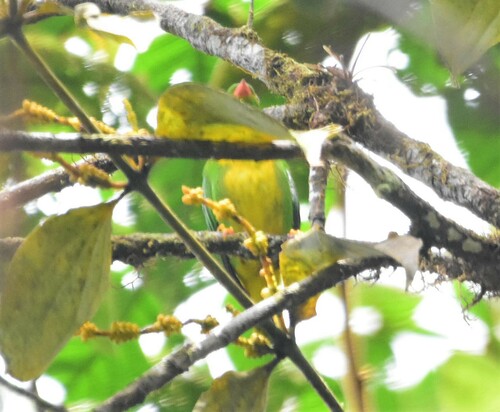 Yellow-collared ChlorophoniaChlorophonia flavirostrisThe yellow-collared chlorophonia is a chunky, short-tailed, stubby-billed bird.
Learn the Puerto Rican Euphonia in the BeakBrain App
Photo and call practice. Coming soon to iPhone and Android.
Play today's Daily BirdEvery photo and recording on this page is credited to its author under the licence shown. Spotted a problem with this page, or have a better photo? Contribute.