Learn what every symbol on the card means.Full credits and sources at beakbrain.com/symbols
 ForestMedium · 114 g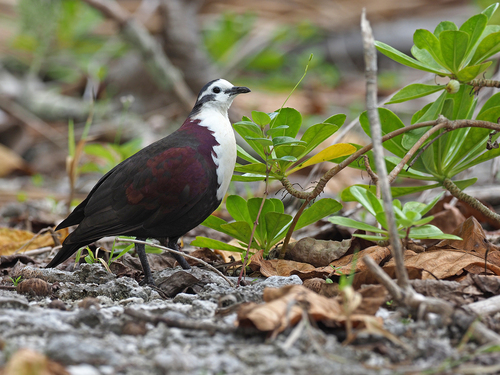
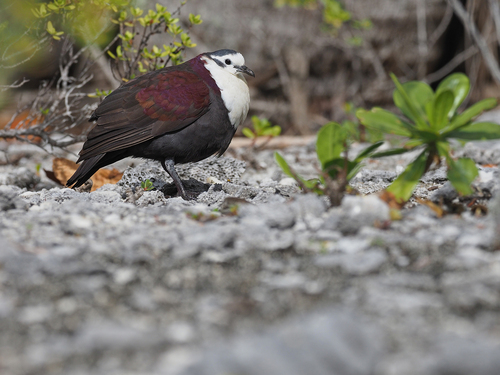
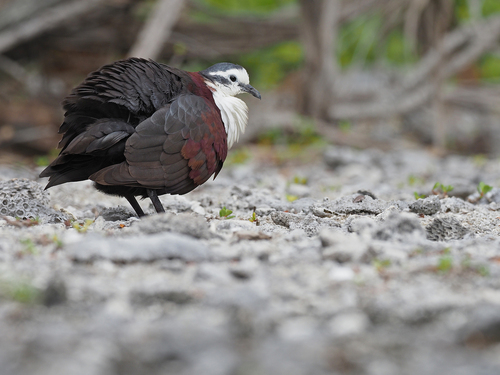


ID tip
The Polynesian ground dove is a small, plump ground dove that displays sexual dimorphism. The male Polynesian ground doves of the nominate subspecies have white foreheads, cheeks, throats, and breasts. The crown, nape, and auricular stripe are grey. The upperparts are a dark olive grey with purple or, if the feathers have faded, chestnut red iridescence on the hindneck and wing-coverts. The underparts are blackish. In males of the subspecies albicollis, the head is completely white.
Text from Wikipedia, licensed CC BY-SA 4.0.
When to see the Polynesian Ground Dove
One bar for each month. Filled bars are the 4 months with records; pale bars are months with none. The wide bar is September, the month with the most records.
Where to see the Polynesian Ground Dove
The map shades 1 country with regular records. Everything unshaded has no records. Countries are listed below the map.
About the Polynesian Ground Dove
The Polynesian ground dove or Society Islands ground dove or Tutururu is a critically endangered species of bird in the family Columbidae. Originally endemic to the Society Islands and Tuamotus in French Polynesia, it has now been extirpated from most of its former range by habitat loss and predation by introduced species such as cats and rats, and the species is now endemic only in the Acteon islands. The total population is estimated to be around 100-120 birds.
Text adapted from Wikipedia, licensed CC BY-SA 4.0.
Easily confused with
 Marquesan Ground DovePampusana rubescensThe Marquesan ground dove or Marquesas ground dove is a bird species in the family Columbidae.
Santa Cruz Ground DovePampusana sanctaecrucisThe Santa Cruz ground dove is a species of bird in the family Columbidae.
Marquesan Ground DovePampusana rubescensThe Marquesan ground dove or Marquesas ground dove is a bird species in the family Columbidae.
Santa Cruz Ground DovePampusana sanctaecrucisThe Santa Cruz ground dove is a species of bird in the family Columbidae.
 Wetar Ground DovePampusana hoedtiiBody length is about 27 cm (11 in) long.
Learn the Polynesian Ground Dove in the BeakBrain App
Photo and call practice. Coming soon to iPhone and Android.
Play today's Daily BirdEvery photo and recording on this page is credited to its author under the licence shown. Spotted a problem with this page, or have a better photo? Contribute.