Learn what every symbol on the card means.Full credits and sources at beakbrain.com/symbols
 GrasslandScrapeMedium · 63 g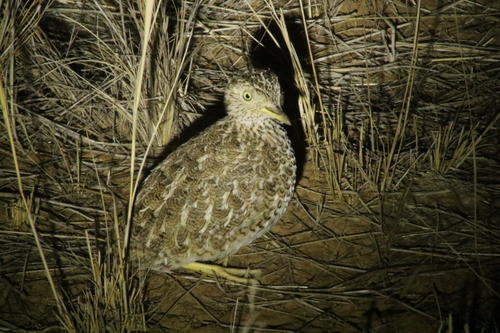
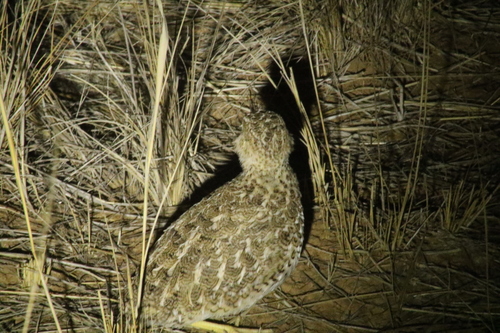


ID tip
The plains-wanderer is a quail-like ground bird, measuring 15–19 cm. It is such an atypical bird that it is placed in an entire family of its own, Pedionomidae. The adult male is light brown above, with fawn-white underparts with black crescents. The adult female is substantially larger than the male, and has a distinctive, white-spotted black collar. They have excellent camouflage and will first hide at any disturbance. If approached too closely, they will run rather than fly, at which they are very poor. Females lay four eggs, which the male then incubates.
Text from Wikipedia, licensed CC BY-SA 4.0.
When to see the Plains-wanderer
One bar for each month, and every month is filled: this bird is recorded here in all twelve. The wide bar is November, the month with the most records.
Where to see the Plains-wanderer
The map shades 1 country with regular records. Everything unshaded has no records. Countries are listed below the map.
About the Plains-wanderer
The plains-wanderer is an atypical species of wading bird, the only representative of family Pedionomidae and genus Pedionomus. It is endemic to Australia. Its historic range included much of eastern Australia, including Victoria, New South Wales, South Australia and the Northern Territory, but in recent years, it has become endangered with remaining known populations concentrated in the Riverina region of New South Wales and western Queensland.
Text adapted from Wikipedia, licensed CC BY-SA 4.0.
Learn the Plains-wanderer in the BeakBrain App
Photo and call practice. Coming soon to iPhone and Android.
Play today's Daily BirdEvery photo and recording on this page is credited to its author under the licence shown. Spotted a problem with this page, or have a better photo? Contribute.