Learn what every symbol on the card means.Full credits and sources at beakbrain.com/symbols
 ForestCavity nestSmall · 39 g


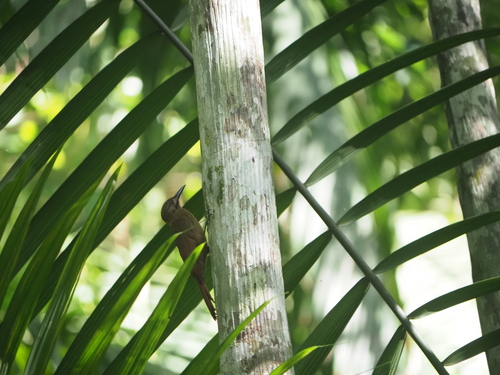
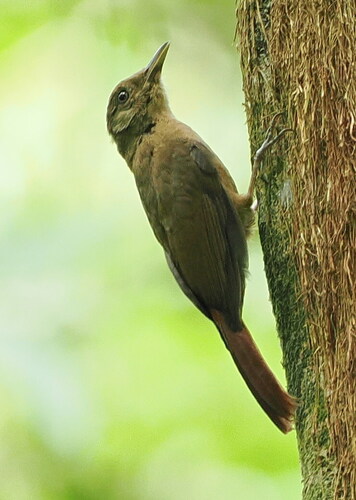
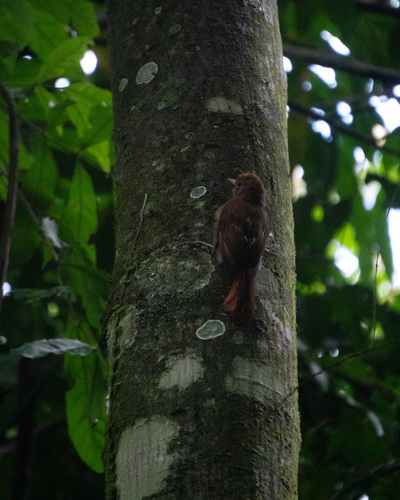
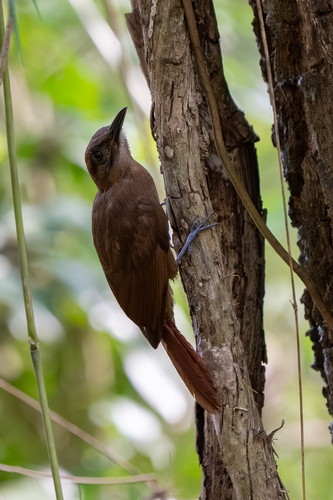

What the Plain-brown Woodcreeper sounds like


ID tip
The plain-brown woodcreeper is 19 to 22.5 cm (7.5 to 8.9 in) long. Males weigh 30 to 50 g (1.1 to 1.8 oz) and females 25 to 46 g (0.88 to 1.6 oz). The species is a medium-sized member of its genus, with a straight medium-length bill and a slight crest. The sexes have the same plumage but females are smaller than males. The nominate subspecies D. f. fuliginosa has a narrow buff supercilium and a faint buff stripe under an otherwise grayish face. Its crown, nape, back, and wing coverts are dull olive-brown; its uppertail coverts and tail are rufous-chestnut. Voice: The plain-brown woodcreeper's song is variously described as a long whinny, rattle, or sputter. It has been put into words as "Whee-hee-he-hah-huh-huh-huh-huh-huh-huh-huh-hu-hu-hu-hu-hu-hu-hoo-hoo-hooh, wee-i-woo!", "keé-keé-keé-kee-kee-kee-kew-kew-kew", and a "long series of sweeping 'weekweekweek---' notes". It makes a wide variety of calls; the most frequent are "peeyk" (or "PWEEK!
Text from Wikipedia, licensed CC BY-SA 4.0.
When to see the Plain-brown Woodcreeper
One bar for each month, and every month is filled: this bird is recorded here in all twelve. The wide bar is October, the month with the most records.
Where to see the Plain-brown Woodcreeper
The map shades 16 countries with regular records. Everything unshaded has no records. Countries are listed below the map.
About the Plain-brown Woodcreeper
The plain-brown woodcreeper, is a sub-oscine passerine bird in subfamily Dendrocolaptinae of the ovenbird family Furnariidae. It is found in the tropical New World from Honduras through South America to central Brazil and in Trinidad and Tobago.
Text adapted from Wikipedia, licensed CC BY-SA 4.0.
Easily confused with
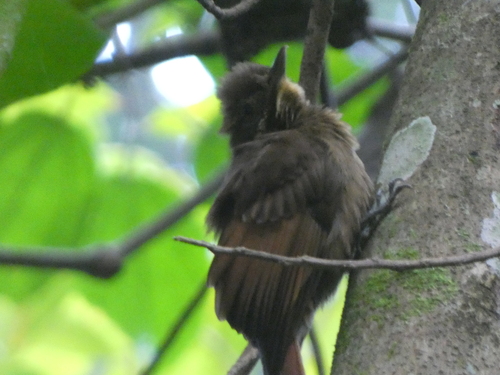 Tawny-winged WoodcreeperDendrocincla anabatinaThe tawny-winged woodcreeper is 17 to 19 cm (6.7 to 7.5 in) long.
 Ruddy WoodcreeperDendrocincla homochroaThe ruddy woodcreeper is 17.5 to 20.5 cm (6.9 to 8.1 in) long.
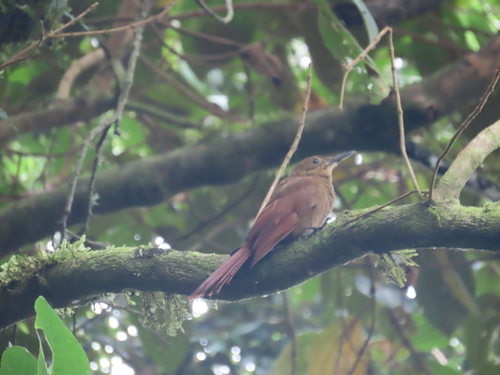 Tyrannine WoodcreeperDendrocincla tyranninaThe tyrannine woodcreeper is rather larger and heavier than most others of its genus.
Side by side: Plain-brown Woodcreeper vs Tawny-winged Woodcreeper · Plain-brown Woodcreeper vs Ruddy Woodcreeper · Plain-brown Woodcreeper vs Tyrannine Woodcreeper
Learn the Plain-brown Woodcreeper in the BeakBrain App
Photo and call practice. Coming soon to iPhone and Android.
Play today's Daily BirdEvery photo and recording on this page is credited to its author under the licence shown. Spotted a problem with this page, or have a better photo? Contribute.