Learn what every symbol on the card means.Full credits and sources at beakbrain.com/symbols
 ForestMedium · 287 g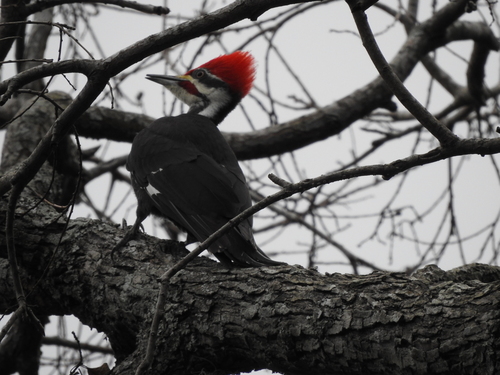

What the Pileated Woodpecker sounds like


ID tip
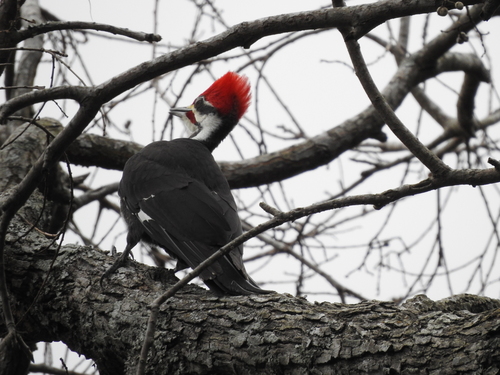
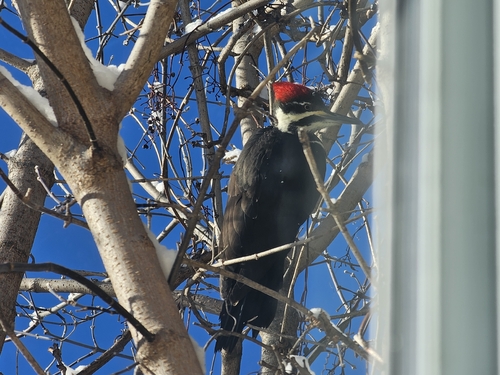
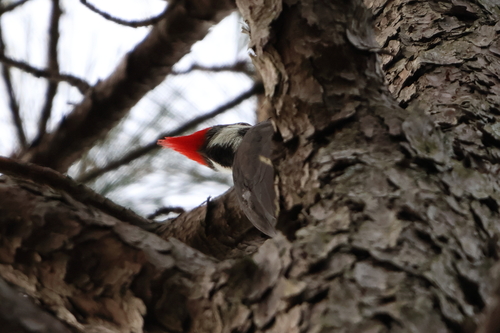
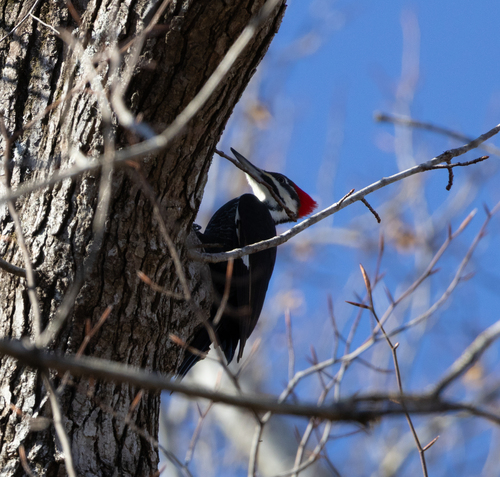
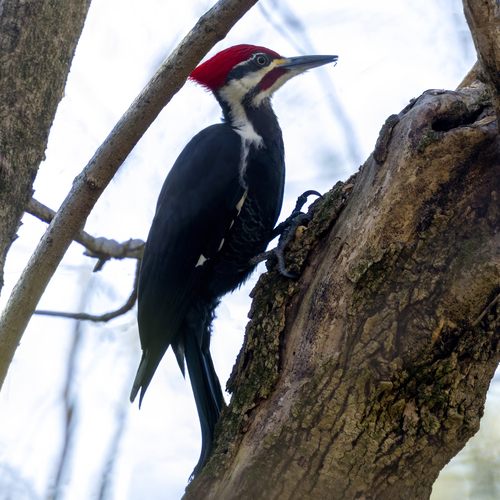
Pileated woodpeckers are mainly black with a red crest and have a white line down the sides of the throat. Adult males have a red line from the bill to the throat; in adult females, these are black. They also have white wing feathers that show when in flight. Adults are 40 to 49 cm (16 to 19 in) long, span 66 to 75 cm (26 to 30 in) across the wings, and weigh 225 to 400 g (7.9 to 14.1 oz). The average weight of females and males combined is about 277 g (9.8 oz), with males weighing about 300 g (11 oz) and females weighing about 256 g (9.0 oz) in mean body mass. The wing chord measures 21.
Text from Wikipedia, licensed CC BY-SA 4.0.
When to see the Pileated Woodpecker
One bar for each month, and every month is filled: this bird is recorded here in all twelve. The wide bar is May, the month with the most records.
Where to see the Pileated Woodpecker
The map shades 2 countries with regular records. Everything unshaded has no records. Countries are listed below the map.
About the Pileated Woodpecker
The pileated woodpecker is a large, crow-sized woodpecker with a prominent red crest, white neck stripe, and a mostly black body. This woodpecker is native to North America, where it is the largest confirmed extant woodpecker species and the third-largest extant species of woodpecker in the world, after the great slaty woodpecker and the black woodpecker. It inhabits deciduous forests in eastern North America, the Great Lakes, the boreal forests of Canada, and parts of the Pacific Coast.
Text adapted from Wikipedia, licensed CC BY-SA 4.0.
Easily confused with
 Black WoodpeckerDryocopus martiusThe black woodpecker measures 45 to 55 cm (18 to 22 in) long with a 64 to 84 cm (25 to 33 in) wingspan.
 Lineated WoodpeckerDryocopus lineatusThe lineated woodpecker is 31.5 to 36 cm (12.4 to 14.2 in) long.
 White-bellied WoodpeckerDryocopus javensisThis species is one of the largest living species of woodpecker.
Side by side: Black Woodpecker vs Pileated Woodpecker · Lineated Woodpecker vs Pileated Woodpecker · Pileated Woodpecker vs White-bellied Woodpecker
Learn the Pileated Woodpecker in the BeakBrain App
Photo and call practice. Coming soon to iPhone and Android.
Play today's Daily BirdEvery photo and recording on this page is credited to its author under the licence shown. Spotted a problem with this page, or have a better photo? Contribute.