Learn what every symbol on the card means.Full credits and sources at beakbrain.com/symbols
 ForestCavity nestMedium · 119 g

ID tip
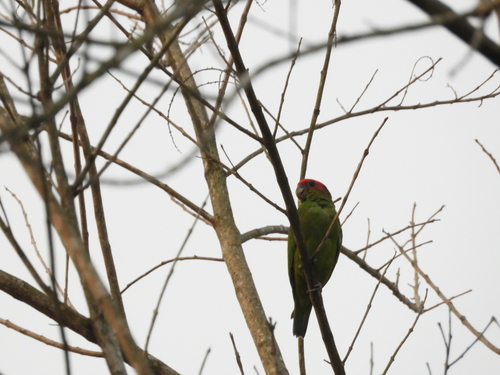
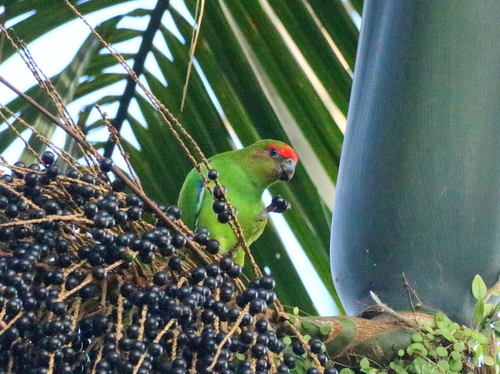
The pileated parrot is 20 to 22 cm (7.9 to 8.7 in) long and weighs 98 to 120 g (3.5 to 4.2 oz). Adults have an essentially all green body, with a yellowish abdomen. Their primaries, primary coverts, and the edges and tips of their tail feathers are dull blue. Males have a red forehead, crown, lores, and upper ear coverts. Females do not have any red but do have a faint blue wash on the forehead and breast. Immature males have less red on the head than adults, and females have less blue on the wings. Voice: The pileated parrot call is "very high, piercing shrieks, like 'tjeéreweét'." Its flight call is a "high 'tjer-tjer'tjer- -'."
Text from Wikipedia, licensed CC BY-SA 4.0.
When to see the Pileated Parrot
One bar for each month, and every month is filled: this bird is recorded here in all twelve. The wide bar is October, the month with the most records.
Where to see the Pileated Parrot
The map shades 3 countries with regular records. Everything unshaded has no records. Countries are listed below the map.
About the Pileated Parrot
The South American pileated parrot is a species of bird in subfamily Arinae of the family Psittacidae, the African and New World parrots. It is found in Argentina, Brazil, and Paraguay. It was formerly known as the red-capped parrot, easily leading to confusion with the Australian Purpureicephalus spurius that bears that English name.
Text adapted from Wikipedia, licensed CC BY-SA 4.0.
Easily confused with
 Golden-capped ParakeetAratinga auricapillusIt is 30 cm (12 in) long and mostly green with a black beak, white eyerings, orange-red belly, and red face fading to yellow over the crown.
 Caatinga ParakeetEupsittula cactorumThe Caatinga parakeet is about 25 cm (9.8 in) long.
 Lilac-crowned AmazonAmazona finschiThe plumage of an adult lilac-crowned amazon is primarily green with yellowish underparts and black edging.
Side by side: Golden-capped Parakeet vs Pileated Parrot · Caatinga Parakeet vs Pileated Parrot · Lilac-crowned Amazon vs Pileated Parrot
Learn the Pileated Parrot in the BeakBrain App
Photo and call practice. Coming soon to iPhone and Android.
Play today's Daily BirdEvery photo and recording on this page is credited to its author under the licence shown. Spotted a problem with this page, or have a better photo? Contribute.