Learn what every symbol on the card means.Full credits and sources at beakbrain.com/symbols
 ForestCavity nestSmall · 27 g

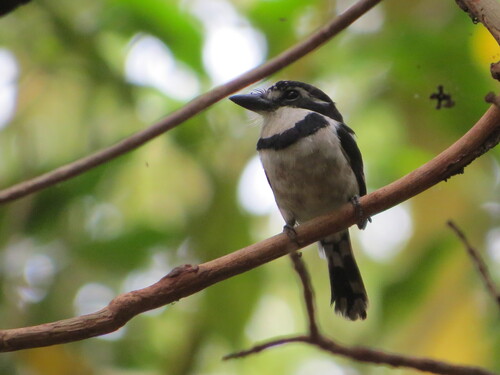
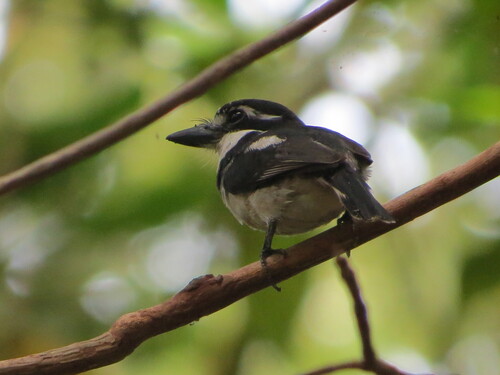
ID tip
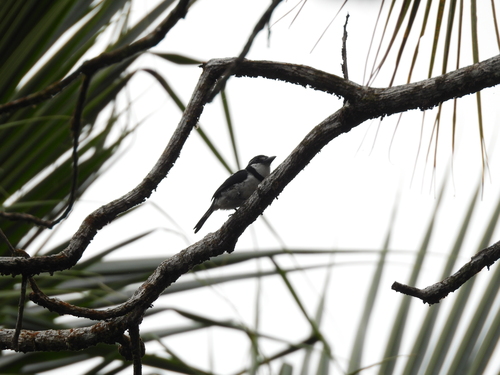
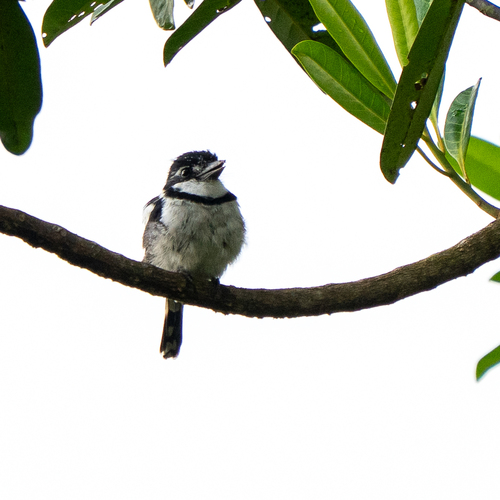
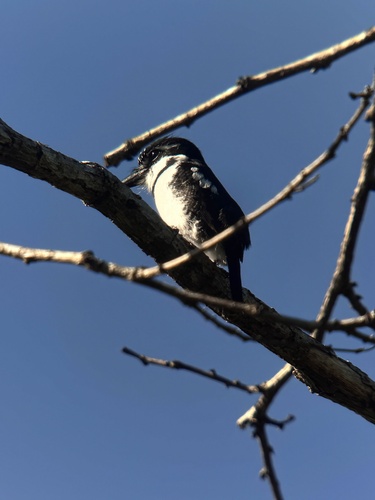
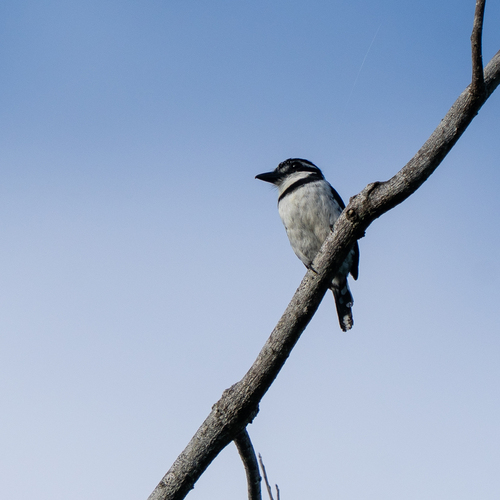
The pied puffbird is 14 to 17 cm (5.5 to 6.7 in) long and weighs 21 to 40 g (0.74 to 1.41 oz). The nominate subspecies is mostly glossy black above and white below. It has a white line from the bill through the eye, white speckles on the crown, a large white spot on the scapulars, and white near the base of the tail and at its end. A broad black band separates the breast from the belly and the flanks are barred black and white. N. t. picatus is larger and darker than the nominate, with less white on the tail feathers. N. t. Voice: The pied puffbird's song differs somewhat between the subspecies. Those of the nominate and N. t. picatus is described as a "thin but loud, high-pitched, bat-like series of whistles, 'tee-oo' or 'pweee pweee pweee' in various patterns". That of N. t. subtectus is "apparently higher-pitched and possibly more piping, less modulated".
Text from Wikipedia, licensed CC BY-SA 4.0.
When to see the Pied Puffbird
One bar for each month, and every month is filled: this bird is recorded here in all twelve. The wide bar is March, the month with the most records.
Where to see the Pied Puffbird
The map shades 12 countries with regular records. Everything unshaded has no records. Countries are listed below the map.
About the Pied Puffbird
The pied puffbird is a species of bird in the family Bucconidae, the puffbirds, nunlets, and nunbirds. It is found in Bolivia, Brazil, Colombia, Costa Rica, Ecuador, French Guiana, Guyana, Nicaragua, Panama, Peru, Suriname, and Venezuela.
Text adapted from Wikipedia, licensed CC BY-SA 4.0.
Easily confused with
 Black-breasted PuffbirdNotharchus pectoralisThe black-breasted puffbird is 19 to 23 cm (7.5 to 9.1 in) long and weighs between 60 and 69 g (2.1 and 2.4 oz).
 White-necked PuffbirdNotharchus hyperrhynchusThe white-necked puffbird is about 25 cm (9.8 in) long and weighs 81 to 106 g (2.9 to 3.7 oz).It is mostly glossy black.
 Buff-bellied PuffbirdNotharchus swainsoniThe buff-bellied puffbird is about 23.5 cm (9.3 in) long and weighs 72 to 75.6 g (2.5 to 2.7 oz).
Side by side: Pied Puffbird vs White-necked Puffbird · Black-breasted Puffbird vs Pied Puffbird
Learn the Pied Puffbird in the BeakBrain App
Photo and call practice. Coming soon to iPhone and Android.
Play today's Daily BirdEvery photo and recording on this page is credited to its author under the licence shown. Spotted a problem with this page, or have a better photo? Contribute.