Learn what every symbol on the card means.Full credits and sources at beakbrain.com/symbols
 ForestPlatform nestLarge · 500 g


ID tip
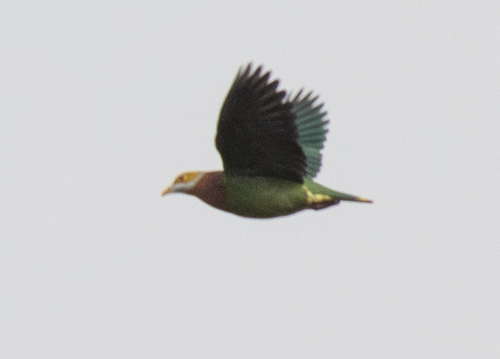
The pheasant pigeon resembles a pheasant in external morphology, particularly in its laterally compressed tail and rounded wings. They have glossy black heads, undersides, rears and lower backs, and short rounded brown wings, and a white, green, grey, or black nape depending on the subspecies. The pheasant pigeon has filled the ecological niche of a partridge or small pheasant (while the larger Goura crowned pigeons have a lifestyle similar to larger pheasants, grouse or turkeys). It is a highly secretive species, feeding on seeds and fallen fruits.
Text from Wikipedia, licensed CC BY-SA 4.0.
When to see the Pheasant Pigeon
One bar for each month. Filled bars are the 10 months with records; pale bars are months with none. The wide bar is July, the month with the most records.
Where to see the Pheasant Pigeon
The map shades 2 countries with regular records. Everything unshaded has no records. Countries are listed below the map.
About the Pheasant Pigeon
The pheasant pigeon is a species of large terrestrial pigeon. It is the only species of the monotypic genus Otidiphaps. The pheasant pigeon is found in the primary rainforests of New Guinea and nearby islands. It ranges primarily over hilly and lower mountain areas, but can also be found in lowlands.
Text adapted from Wikipedia, licensed CC BY-SA 4.0.
Easily confused with


Learn the Pheasant Pigeon in the BeakBrain App
Photo and call practice. Coming soon to iPhone and Android.
Play today's Daily BirdEvery photo and recording on this page is credited to its author under the licence shown. Spotted a problem with this page, or have a better photo? Contribute.