Learn what every symbol on the card means.Full credits and sources at beakbrain.com/symbols
 ShrublandCup nestSmall · 22 g


ID tip
The phainopepla is a striking bird, 16–20 cm (6.3–7.9 in) long with a noticeable crest and a long tail; it is slender, and has an upright posture when it perches. Its bill is short and slender. The male is glossy black, and has a white wing patch that is visible when it flies; the female is plain gray and has a lighter gray wing patch. Both sexes have red eyes, but these are more noticeable in the female than the male. Voice: Phainopeplas have been found to imitate the calls of twelve other species, such as the red-tailed hawk (Buteo jamaicensis) and the northern flicker (Colaptes auratus).
Text from Wikipedia, licensed CC BY-SA 4.0.
When to see the Phainopepla
One bar for each month. Filled bars are the 11 months with records; pale bars are months with none. The wide bar is May, the month with the most records.
Where to see the Phainopepla
The map shades 2 countries with regular records, and 1 more in a lighter tone where the bird turns up only as a stray. Everything unshaded has no records. Countries are listed below the map.
Recorded as a rare visitor in Canada.
About the Phainopepla
The phainopepla or northern phainopepla is the most northerly representative of the mainly tropical Central American family Ptiliogonatidae, the silky flycatchers. Its name is from the Greek phain pepla meaning "shining robe" in reference to the male's plumage.
Text adapted from Wikipedia, licensed CC BY-SA 4.0.
Easily confused with
 Grey Silky-flycatcherPtiliogonys cinereusThe grey silky-flycatcher is 18.5 to 21 cm (7.3 to 8.3 in) long.
 Long-tailed Silky-flycatcherPtiliogonys caudatusThe long-tailed silky-flycatcher is 20 to 24.4 cm (7.9 to 9.6 in) long and weighs about 37 g (1.3 oz).
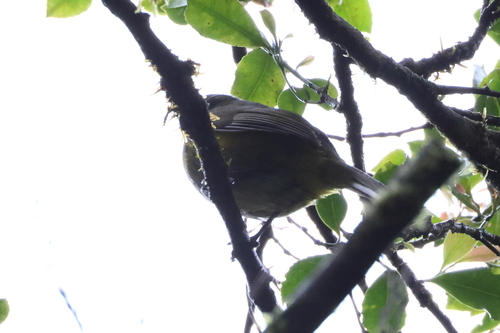 Black-and-yellow PhainoptilaPhainoptila melanoxanthaThe black-and-yellow phainoptila is about 20 cm (7.9 in) long.
Side by side: Grey Silky-flycatcher vs Phainopepla · Long-tailed Silky-flycatcher vs Phainopepla · Black-and-yellow Phainoptila vs Phainopepla
Learn the Phainopepla in the BeakBrain App
Photo and call practice. Coming soon to iPhone and Android.
Play today's Daily BirdEvery photo and recording on this page is credited to its author under the licence shown. Spotted a problem with this page, or have a better photo? Contribute.