Learn what every symbol on the card means.Full credits and sources at beakbrain.com/symbols
 ForestDomed nestSmall · 19 g
ID tip
The Peruvian wren is 15.5 to 16 cm (6.1 to 6.3 in) long and weighs 19.6 g (0.69 oz). The adults' upperparts are rich chestnut, with the crown and rump being redder. They have a variable amount of white on the face. The tail is also rich chestnut and has narrow black bars. The chin and throat are orange-brown and the chest, belly, and flanks are the same hue but darker. The juvenile is believed to resemble the adult but with no white on the face. Voice: Peruvian wren pairs often sing in duet, "a magnificent series of rich trills and clear whistles" . Its call is "a gravelly, chattering 'ch-d-d-d'" .
Text from Wikipedia, licensed CC BY-SA 4.0.
When to see the Peruvian Wren
One bar for each month. Filled bars are the 11 months with records; pale bars are months with none. The wide bar is August, the month with the most records.
Where to see the Peruvian Wren
The map shades 2 countries with regular records, and 1 more in a lighter tone where the bird turns up only as a stray. Everything unshaded has no records. Countries are listed below the map.
Recorded as a rare visitor in Ecuador.
About the Peruvian Wren
The Peruvian wren is a species of bird in the family Troglodytidae. It is endemic to Peru.
Text adapted from Wikipedia, licensed CC BY-SA 4.0.
Easily confused with
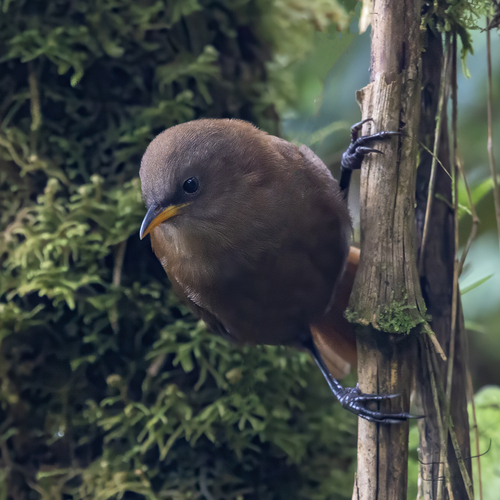 Rufous WrenCinnycerthia unirufaThe rufous wren has a length of about 16.5 cm (6.5 in).
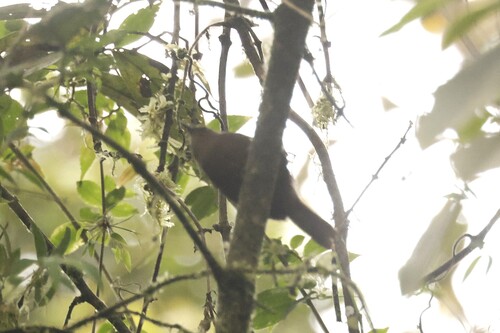 Sepia-brown WrenCinnycerthia olivascensThe sepia-brown wren is 16 cm (6.3 in) long; males weigh an average of 25.9 g (0.91 oz) and females weigh an average of 23 g (0.81 oz).
Learn the Peruvian Wren in the BeakBrain App
Photo and call practice. Coming soon to iPhone and Android.
Play today's Daily BirdEvery photo and recording on this page is credited to its author under the licence shown. Spotted a problem with this page, or have a better photo? Contribute.