Learn what every symbol on the card means.Full credits and sources at beakbrain.com/symbols
 ForestSmall · 35 g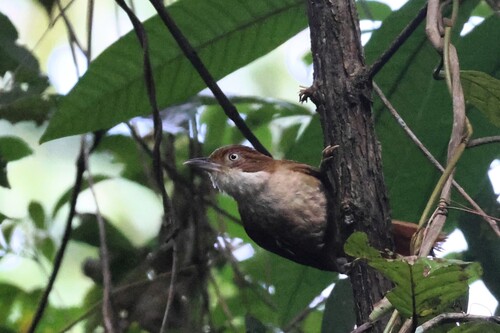
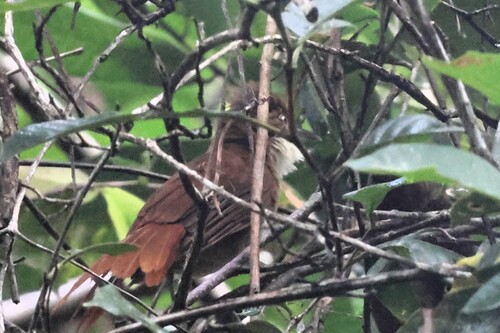
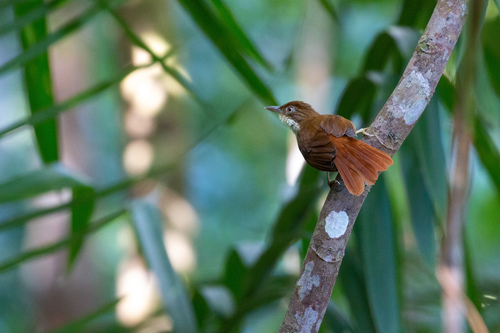
ID tip
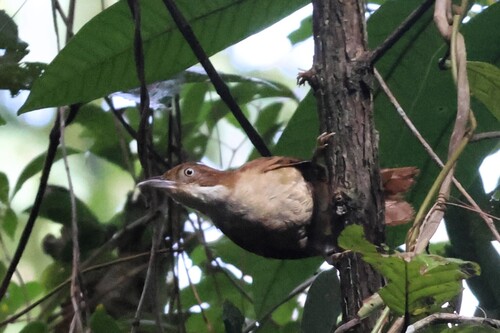
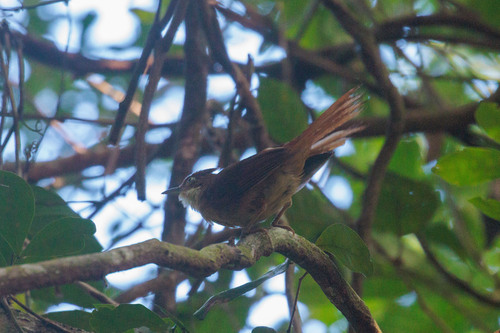
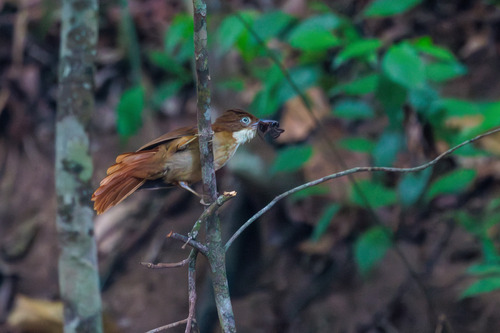
The Pernambuco foliage-gleaner is 19 to 20 cm (7.5 to 7.9 in) long. It is a fairly large member of its genus and has a heavy bill. The sexes have the same plumage, which is similar to that of the formerly conspecific white-eyed foliage-gleaner. Adults of the nominate subspecies have a dark brownish face with faint reddish streaks on the ear coverts, grizzled reddish brown and buffy lores, and a white malar area. Their crown is dark brown with narrow rufous streaks. Their back and rump are dark brown that blends to rufous uppertail coverts. Voice: The Pernambuco foliage-gleaner's song is what sets it apart from the white-eyed foliage-gleaner. It is "a strident series of 2–11 closely spaced (3–4/second), frequency-modulated notes or doublets, each with a particularly harsh, grating quality, but each doublet comprised a harsh note and a sharp thin note". Its call is loud "weck" notes that may be uttered up to 20 times.
Text from Wikipedia, licensed CC BY-SA 4.0.
When to see the Pernambuco Foliage-gleaner
One bar for each month. Filled bars are the 8 months with records; pale bars are months with none. The wide bar is January, the month with the most records.
Where to see the Pernambuco Foliage-gleaner
The map shades 1 country with regular records. Everything unshaded has no records. Countries are listed below the map.
About the Pernambuco Foliage-gleaner
The Pernambuco foliage-gleaner is an endangered species of bird in the Furnariinae subfamily of the ovenbird family Furnariidae. It is endemic to northeastern Brazil.
Text adapted from Wikipedia, licensed CC BY-SA 4.0.
Easily confused with
 Fawn-throated Foliage-gleanerAutomolus cervinigularisThe fawn-throated foliage-gleaner is 18 to 20 cm (7.1 to 7.9 in) long and weighs 30 to 46 g (1.1 to 1.6 oz).
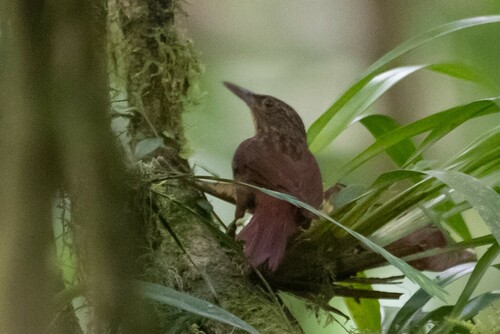 Western WoodhaunterAutomolus virgatusThe western woodhaunter is 17 to 18 cm (6.7 to 7.1 in) long and weighs about 35 g (1.2 oz).
Eastern WoodhaunterAutomolus subulatusThe eastern woodhaunter is 17 to 18 cm (6.7 to 7.1 in) long and weighs about 25 to 38 g (0.88 to 1.3 oz).
Western WoodhaunterAutomolus virgatusThe western woodhaunter is 17 to 18 cm (6.7 to 7.1 in) long and weighs about 35 g (1.2 oz).
Eastern WoodhaunterAutomolus subulatusThe eastern woodhaunter is 17 to 18 cm (6.7 to 7.1 in) long and weighs about 25 to 38 g (0.88 to 1.3 oz).
Learn the Pernambuco Foliage-gleaner in the BeakBrain App
Photo and call practice. Coming soon to iPhone and Android.
Play today's Daily BirdEvery photo and recording on this page is credited to its author under the licence shown. Spotted a problem with this page, or have a better photo? Contribute.