Learn what every symbol on the card means.Full credits and sources at beakbrain.com/symbols
 ForestCavity nestMedium · 163 g

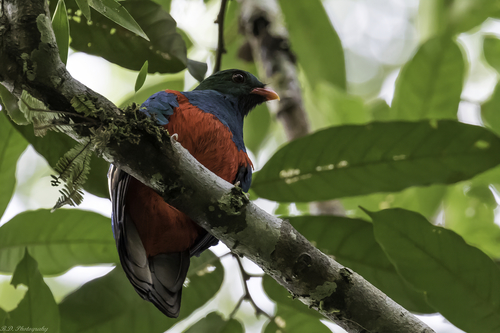
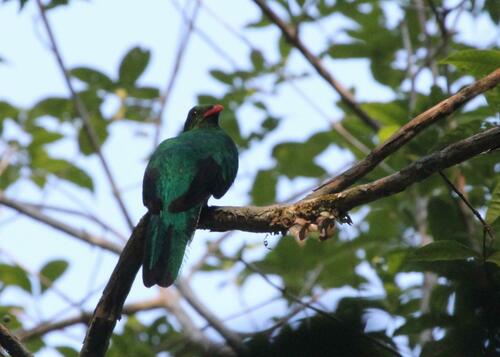
ID tip
Like many other quetzals, pavonine quetzals are fairly brilliantly coloured, exhibiting some sexual dichromatism, with the females being noticeable duller than the males. Overall, they resemble most closely the golden-headed quetzal (Pharomachrus auriceps). Voice: Quetzal vocalizations quite simple in form, loud, and repetitive. While a few variations exist on how to spell out the call of pavonine quetzals, their vocalizations resembles a descending whistle (« ew ewwo ewwo ewwo ewwo »), followed by a « chok » note. The birds will repeat this call around four times in ten seconds, and composes the bulk of their known vocalizations.
Text from Wikipedia, licensed CC BY-SA 4.0.
When to see the Pavonine Quetzal
One bar for each month. Filled bars are the 11 months with records; pale bars are months with none. The wide bar is October, the month with the most records.
Where to see the Pavonine Quetzal
The map shades 6 countries with regular records. Everything unshaded has no records. Countries are listed below the map.
About the Pavonine Quetzal
The pavonine quetzal is a species of bird in the family Trogonidae, the trogons. It is also known at the peacock trogon, red-billed train bearer, or viuda pico rojo in Spanish. The pavonine quetzal lives in the Neotropics, more specifically in the northern region of the Amazon basin, spreading from Colombia to Bolivia. The most notable characteristics helpful in identifying this bird are its plumage, red beak, and its distribution - it is the only quetzal occupying the lowland rainforest east of the Andes.
Text adapted from Wikipedia, licensed CC BY-SA 4.0.
Easily confused with
 White-tipped QuetzalPharomachrus fulgidusVoice: Hilty and colleagues (1986) describe the voice as a loud kirra, or kirra, kip, and when excited kier, kip-kip-kip-a.
 Crested QuetzalPharomachrus antisianusAdult birds are 33–34 cm (13–13+1⁄2 in) long.
 Resplendent QuetzalPharomachrus mocinnoThe resplendent quetzal is the largest trogon.
Learn the Pavonine Quetzal in the BeakBrain App
Photo and call practice. Coming soon to iPhone and Android.
Play today's Daily BirdEvery photo and recording on this page is credited to its author under the licence shown. Spotted a problem with this page, or have a better photo? Contribute.