Learn what every symbol on the card means.Full credits and sources at beakbrain.com/symbols
 ForestMedium · 88 g


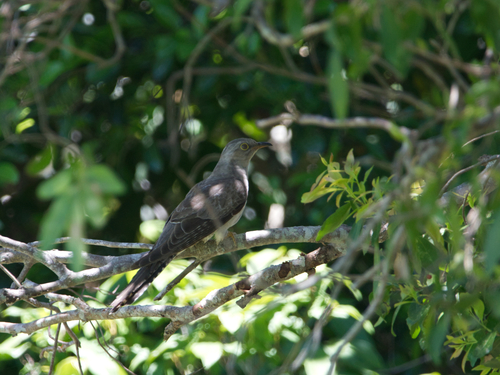
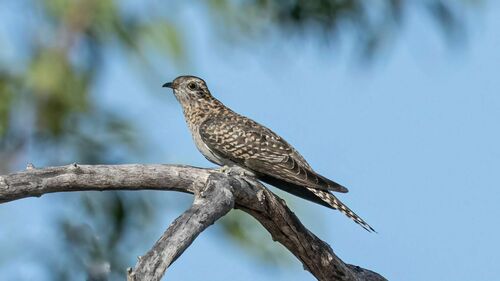
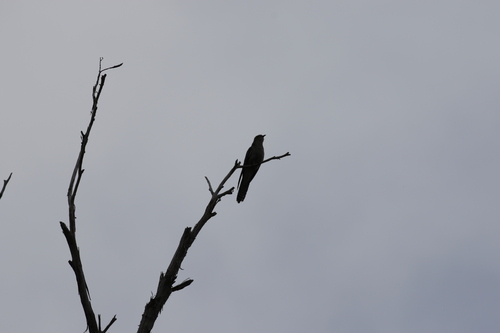
ID tip
Characteristics of the appearance of the pallid cuckoo include: a dark bill, a dark eye with a gold eye-ring, a shadowy dark mark from the eye down the neck, a white (or buff) mark on the nape, olive grey feet and prominent white (or buff) toothing along the tail. In flight, there are conspicuous white and dark bars across the long tail. Its silhouette resembles a falcon and often triggers alarm calls from passerines. The pallid cuckoo can have various morphs including light rufous morph or dark rufous morph.
Text from Wikipedia, licensed CC BY-SA 4.0.
When to see the Pallid Cuckoo
One bar for each month. Filled bars are the 7 months with records; pale bars are months with none. The wide bar is October, the month with the most records.
Where to see the Pallid Cuckoo
The map shades 2 countries with regular records, and 2 more in a lighter tone where the bird turns up only as a stray. Everything unshaded has no records. Countries are listed below the map.
Recorded as a rare visitor in New Zealand, Timor-Leste.
About the Pallid Cuckoo
The pallid cuckoo is a species of cuckoo in the family Cuculidae. It is the only species placed in the genus Heteroscenes. It is found in Australia, with some migration to the islands of Timor and Papua New Guinea. It is between 28 and 33 cm in size, with distinctive markings such as a dark bill, a dark eye with a gold eye-ring and olive grey feet which differentiate it from other cuckoos. The pallid cuckoo is similar in appearance to the oriental cuckoo, with barred immature pallid cuckoos being often mistaken for oriental cuckoos.
Text adapted from Wikipedia, licensed CC BY-SA 4.0.
Easily confused with
 Great Spotted CuckooClamator glandariusThis species is slightly larger than the common cuckoo at 35–39 cm (14–15 in) in length, but looks much larger with its broad wings and long narrow tail.
 Green-billed MalkohaPhaenicophaeus tristisGreen-billed malkoha is about 50–60 cm long and weighs 100–128 g.
 Blue-faced MalkohaPhaenicophaeus viridirostrisA largish species at 39 cm, its back and head are dark grey with an oily green or blue gloss, and the dark tail has graduated feathers tipped with white.
Side by side: Great Spotted Cuckoo vs Pallid Cuckoo · Green-billed Malkoha vs Pallid Cuckoo · Blue-faced Malkoha vs Pallid Cuckoo
Learn the Pallid Cuckoo in the BeakBrain App
Photo and call practice. Coming soon to iPhone and Android.
Play today's Daily BirdEvery photo and recording on this page is credited to its author under the licence shown. Spotted a problem with this page, or have a better photo? Contribute.