Learn what every symbol on the card means.Full credits and sources at beakbrain.com/symbols
 ForestSmall · 23 g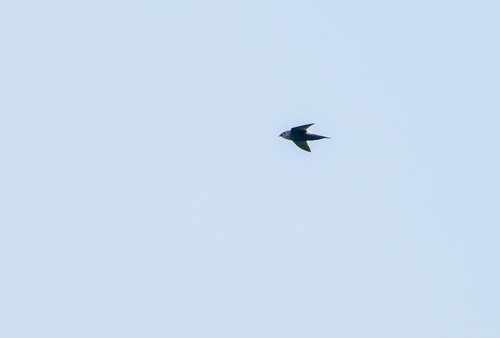
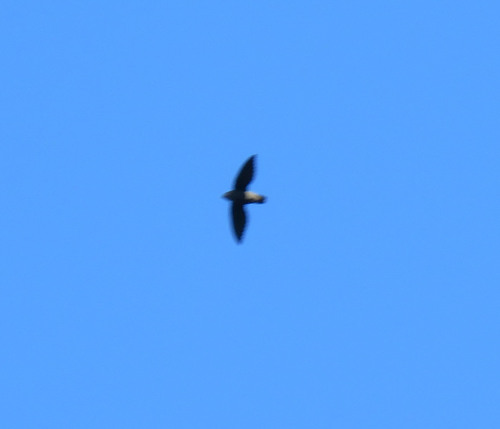
ID tip
The pale-rumped swift is about 10.5 cm (4.1 in) long and weighs about 23 g (0.81 oz). It has a protruding head, a short square tail, and wings that bulge in the middle and somewhat hook at the end. The sexes are alike. Their upperparts are black with a bronze gloss and a whitish rump and uppertail coverts. Their underparts are mostly dark, with a pale throat and blackish undertail coverts. Voice: The pale-rumped swift's main vocalizations are "a single-noted 'tsee'...and more complex twittering calls such as 'tsee-titi' or 'titi-tsee-trtr'."
Text from Wikipedia, licensed CC BY-SA 4.0.
When to see the Pale-rumped Swift
One bar for each month. Filled bars are the 8 months with records; pale bars are months with none. The wide bar is August, the month with the most records.
Where to see the Pale-rumped Swift
The map shades 5 countries with regular records. Everything unshaded has no records. Countries are listed below the map.
About the Pale-rumped Swift
The pale-rumped swift is a species of bird in subfamily Apodinae of the swift family Apodidae. It is found in Bolivia, Brazil, Colombia, Ecuador, and Peru.
Text adapted from Wikipedia, licensed CC BY-SA 4.0.
Easily confused with
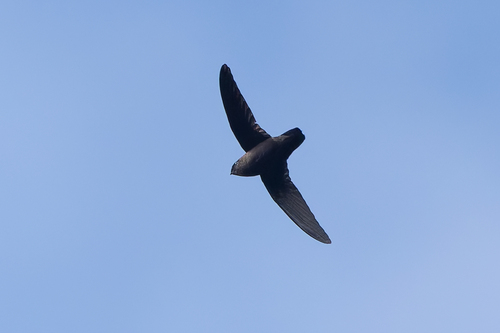 Lesser Antillean SwiftChaetura martinicaThe Lesser Antillean swift is 10.5 to 11 cm (4.1 to 4.3 in) long and weighs an average of 12.7 g (0.45 oz).
Ashy-tailed SwiftChaetura andreiAshy-tailed swift is very similar to the widespread Vaux's swift.
Lesser Antillean SwiftChaetura martinicaThe Lesser Antillean swift is 10.5 to 11 cm (4.1 to 4.3 in) long and weighs an average of 12.7 g (0.45 oz).
Ashy-tailed SwiftChaetura andreiAshy-tailed swift is very similar to the widespread Vaux's swift.
Side by side: Band-rumped Swift vs Pale-rumped Swift · Costa Rican Swift vs Pale-rumped Swift
Learn the Pale-rumped Swift in the BeakBrain App
Photo and call practice. Coming soon to iPhone and Android.
Play today's Daily BirdEvery photo and recording on this page is credited to its author under the licence shown. Spotted a problem with this page, or have a better photo? Contribute.