Learn what every symbol on the card means.Full credits and sources at beakbrain.com/symbols
 ForestMedium · 153 g

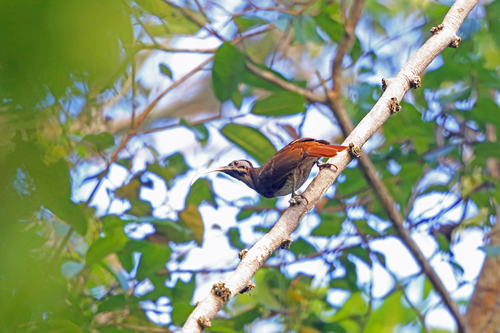
ID tip
Pale-billed sicklebills are on the more medium-sized side of the family Paradisaeidae; they seldom reach over 35 cm, or 13.7 inches, in length. They are among the least attractive birds-of-paradise, being a dull brownish-olive on their upperside, with a greyish-brown underside. Their heads are dark brown, and one of their most noticeable features are lead-grey bare facial patches surrounding each eye and covering most of the head; there are also two iridescent tufts rising above the head. Unlike their congener's bill, they have a pale, ivory-ish colored, downcurved bill.
Text from Wikipedia, licensed CC BY-SA 4.0.
When to see the Pale-billed Sicklebill
One bar for each month. Filled bars are the 6 months with records; pale bars are months with none. The wide bar is August, the month with the most records.
Where to see the Pale-billed Sicklebill
The map shades 1 country with regular records. Everything unshaded has no records. Countries are listed below the map.
About the Pale-billed Sicklebill
The pale-billed sicklebill is a species of sicklebill that belongs to the family Paradisaeidae, which contains the birds-of-paradise.
Text adapted from Wikipedia, licensed CC BY-SA 4.0.
Easily confused with
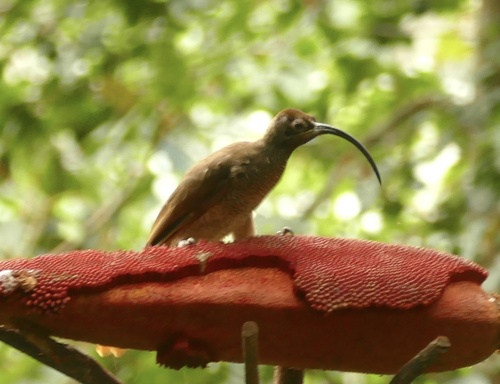
Learn the Pale-billed Sicklebill in the BeakBrain App
Photo and call practice. Coming soon to iPhone and Android.
Play today's Daily BirdEvery photo and recording on this page is credited to its author under the licence shown. Spotted a problem with this page, or have a better photo? Contribute.