Learn what every symbol on the card means.Full credits and sources at beakbrain.com/symbols
 ShrublandCavity nestTiny · 11 g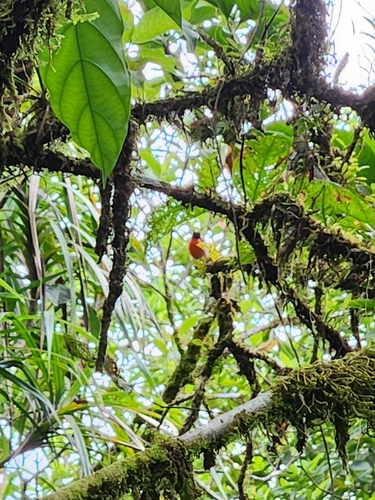

ID tip
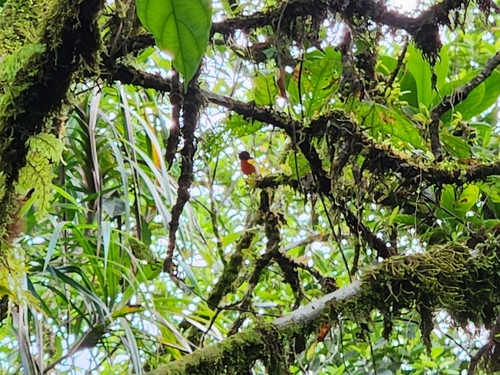
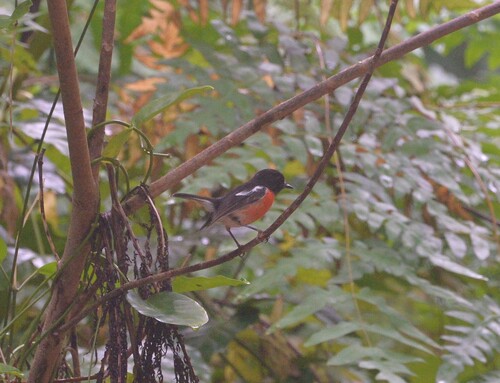
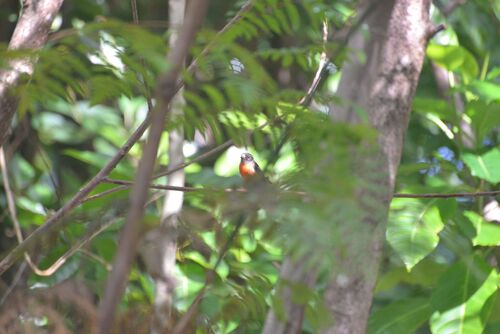
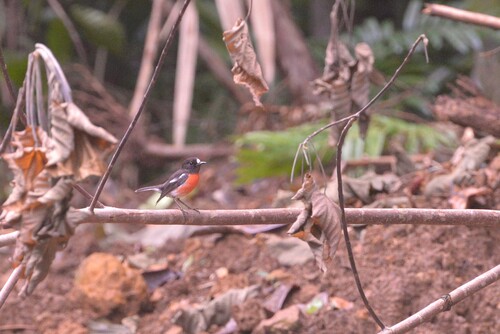
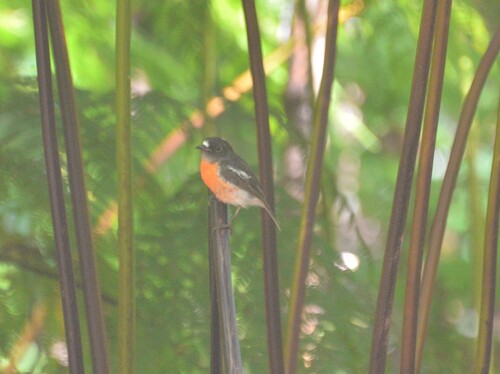
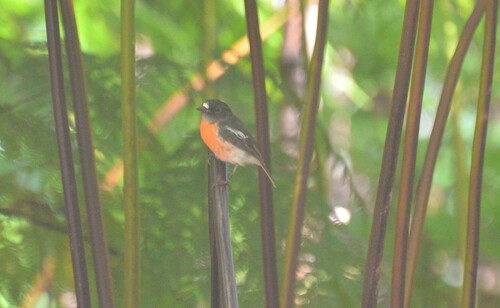
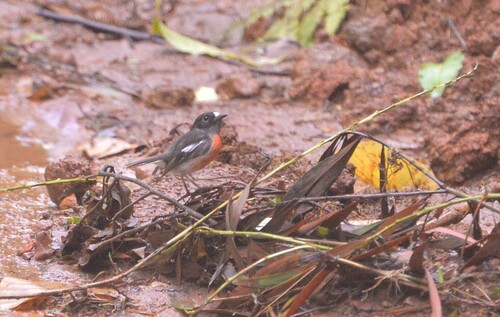
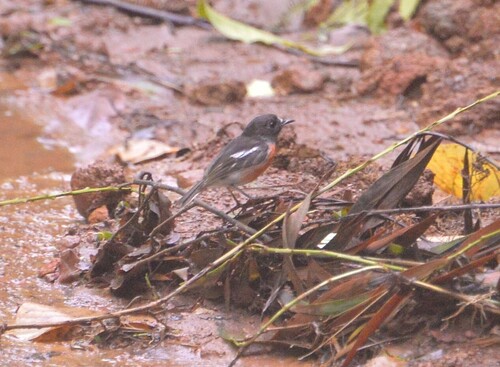
The Pacific robin is a small passerine, 11.5–13.5 cm long and weighing 9–11 g. Over much of its range, it is the smallest species of bird. The plumage of the males and females is dimorphic, and the extent of this varies depending on the subspecies. The male of the nominate race has a black head with a white forehead, a black back and tail, and the wings are also black with a white bar. The breast and belly are red, and the lower belly and rump are white. The female lacks the white forehead and the white bar on the wing; and the black plumage of the male is replaced by dark brown feathers.
Text from Wikipedia, licensed CC BY-SA 4.0.
When to see the Pacific Robin
One bar for each month. Filled bars are the 10 months with records; pale bars are months with none. The wide bar is August, the month with the most records.
Where to see the Pacific Robin
The map shades 3 countries with regular records. Everything unshaded has no records. Countries are listed below the map.
About the Pacific Robin
The Pacific robin, is a red-breasted Australasian robin in the passerine bird genus Petroica found in Melanesia and Polynesia. It is similar in plumage to the scarlet robin of Australia, and until recently the two were considered conspecific until split in 1999 by Schodde and Mason. Thirteen subspecies of Pacific robin are currently recognised, and these subspecies display considerable variation in plumage, foraging preferences, and habitat. The Norfolk robin was previously considered a subspecies of the Pacific robin, but is now considered a distinct species.
Text adapted from Wikipedia, licensed CC BY-SA 4.0.
Easily confused with
 Black RobinPetroica traversiThe black robin is a small, sparrow-sized bird measuring 10–15 centimetres (3.9–5.9 in).
Mountain RobinPetroica bivittataThe mountain robin, also known as subalpine robin, alpine robin or cloud-forest robin, is a species of bird in the family Petroicidae.
Solomons RobinPetroica polymorphaThe Solomons robin is a species of bird in the family Petroicidae.
Black RobinPetroica traversiThe black robin is a small, sparrow-sized bird measuring 10–15 centimetres (3.9–5.9 in).
Mountain RobinPetroica bivittataThe mountain robin, also known as subalpine robin, alpine robin or cloud-forest robin, is a species of bird in the family Petroicidae.
Solomons RobinPetroica polymorphaThe Solomons robin is a species of bird in the family Petroicidae.
Learn the Pacific Robin in the BeakBrain App
Photo and call practice. Coming soon to iPhone and Android.
Play today's Daily BirdEvery photo and recording on this page is credited to its author under the licence shown. Spotted a problem with this page, or have a better photo? Contribute.