Learn what every symbol on the card means.Full credits and sources at beakbrain.com/symbols
 ForestCavity nestMedium · 280 g


ID tip
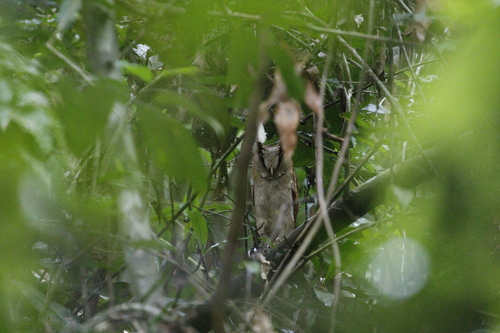
Individuals are small, with distinguishing features such as highly angular heads. The top and back half of their bodies are a deep chestnut color while the bottom of their bodies as well as their stomachs are a cream and tanish color. Oriental bay owls have large, striking black eyes which are highlighted due to the color contrast of their faces. Being that they are small and typically stand upright, they are very difficult to spot as they find comfort in their vast range of habitats.
Text from Wikipedia, licensed CC BY-SA 4.0.
When to see the Oriental Bay Owl
One bar for each month, and every month is filled: this bird is recorded here in all twelve. The wide bar is March, the month with the most records.
Where to see the Oriental Bay Owl
The map shades 8 countries with regular records, and 1 more in a lighter tone where the bird turns up only as a stray. Everything unshaded has no records. Countries are listed below the map.
Recorded as a rare visitor in Indonesia.
About the Oriental Bay Owl
The Oriental bay owl is a species of bay owl. It is completely nocturnal, and can be found throughout Southeast Asia and parts of India. It has several subspecies. It has a heart-shaped face with earlike extensions. The Congo bay owl was formerly classified as a subspecies of Oriental bay owl due to insufficient knowledge, but it has turned out that it might not even belong to the same genus. The Sri Lanka bay owl was also considered a subspecies.
Text adapted from Wikipedia, licensed CC BY-SA 4.0.
Easily confused with
Learn the Oriental Bay Owl in the BeakBrain App
Photo and call practice. Coming soon to iPhone and Android.
Play today's Daily BirdEvery photo and recording on this page is credited to its author under the licence shown. Spotted a problem with this page, or have a better photo? Contribute.