Learn what every symbol on the card means.Full credits and sources at beakbrain.com/symbols
 ForestMedium · 241 g
ID tip
The orange-necked partridge is about 27 cm (11 in) long and weighs about 241 g (8.5 oz). The forehead and crown are dusky, and the nape is mottled brown. A black band extends from the beak to the sides of the neck, and a whitish band extends from the eye to the neck-sides, becoming orange. There is also a black breast-band. The chin is pale buff, and the throat is rusty-orange. The breast is olive-brown, and the belly is greyish and whitish. The flanks have black and white scallops. The back and rump are olive-brown, with dark brown bars. The wing coverts have black and grey bands.
Text from Wikipedia, licensed CC BY-SA 4.0.
When to see the Orange-necked Partridge
One bar for each month. Filled bars are the 7 months with records; pale bars are months with none. The wide bar is March, the month with the most records.
Where to see the Orange-necked Partridge
The map shades 2 countries with regular records. Everything unshaded has no records. Countries are listed below the map.
About the Orange-necked Partridge
The orange-necked partridge is a species of bird in the family Phasianidae. It is found in eastern Cambodia and southern Vietnam. Its habitats are lowland forests, shrubland, and plantations. It was described in 1927 and rediscovered in 1991. It is threatened by habitat loss, and the International Union for Conservation of Nature (IUCN) has assessed it as a near-threatened species.
Text adapted from Wikipedia, licensed CC BY-SA 4.0.
Easily confused with
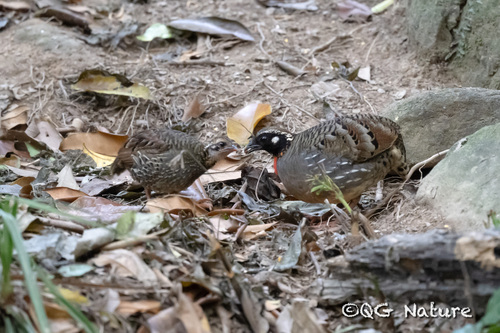 Hainan PartridgeArborophila ardensThe Hainan partridge is 26–28 cm (10–11 in) long.
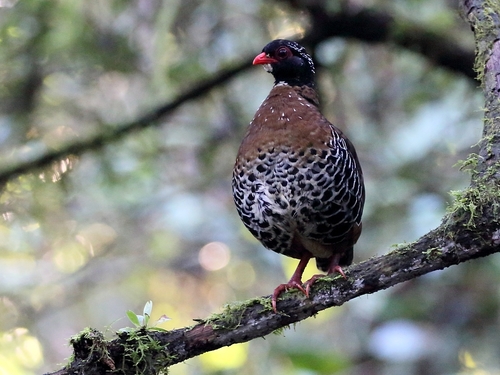 Red-billed PartridgeArborophila rubrirostrisThe red-billed partridge is a bird species in the family Phasianidae.
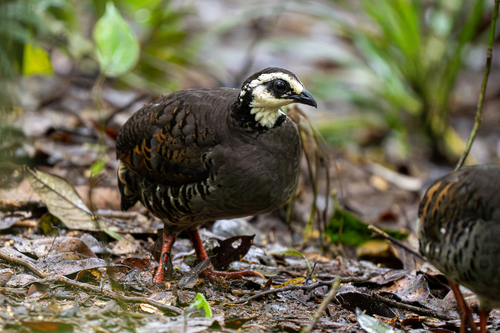 Grey-breasted PartridgeArborophila orientalisThe grey-breasted partridge, also known as the white-faced hill partridge, or Horsfield's hill partridge, is a bird species in the family Phasianidae.
Learn the Orange-necked Partridge in the BeakBrain App
Photo and call practice. Coming soon to iPhone and Android.
Play today's Daily BirdEvery photo and recording on this page is credited to its author under the licence shown. Spotted a problem with this page, or have a better photo? Contribute.