Learn what every symbol on the card means.Full credits and sources at beakbrain.com/symbols
 ForestTiny · 12 g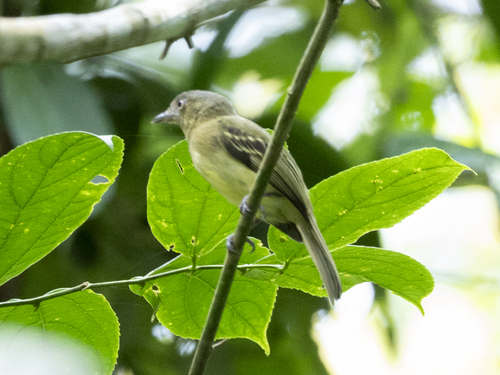
ID tip
The orange-eyed flatbill is about 13.5 cm (5.3 in) long; one male weighed 11.5 g (0.41 oz). The sexes have the same plumage. Adults have a cinnamon forecrown with olive-gray tips on the feathers. They have an olive-gray crown, buff lores, a pale eye-ring, and cinnamon-buff ear coverts. Their nape, back, rump, and uppertail coverts are pale olive-green. Their wings are dusky with greenish yellow edges on the greater coverts that form two wing bars and thin olive-green edges on the flight feather edges, some of which also have a cream far outer edge. Voice: The orange-eyed flatbill is best separated from other flatbills by its voice. One description of its song is "a rising series of short, rising-falling, raspy whistled notes: zreep zreeeep ZREEEP, final note often becoming clearer and more squeaky" and its call is "a rising-falling raspy whistle followed by a low chatter: ZREEE'chirr'rr".
Text from Wikipedia, licensed CC BY-SA 4.0.
When to see the Orange-eyed Flatbill
One bar for each month, and every month is filled: this bird is recorded here in all twelve. The wide bar is May, the month with the most records.
Where to see the Orange-eyed Flatbill
The map shades 3 countries with regular records. Everything unshaded has no records. Countries are listed below the map.
About the Orange-eyed Flatbill
The orange-eyed flatbill or orange-eyed flycatcher is a species of bird in the family Tyrannidae, the tyrant flycatchers. It is found in Colombia, Ecuador, and Peru.
Text adapted from Wikipedia, licensed CC BY-SA 4.0.
Easily confused with
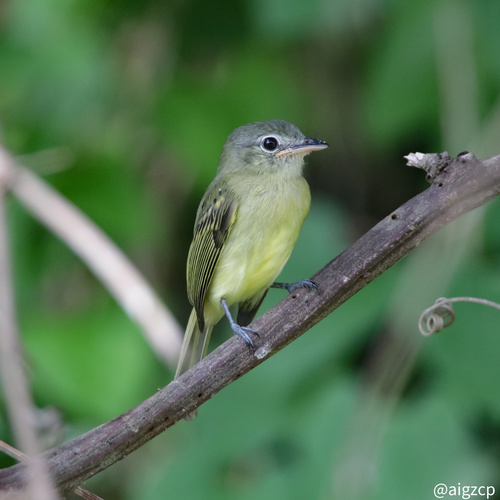 Yellow-winged FlatbillTolmomyias flavotectusThe yellow-winged flatbill is 13 to 13.5 cm (5.1 to 5.3 in) long and weighs about 15 g (0.53 oz).
 Olive-faced FlatbillTolmomyias viridicepsThe olive-faced flatbill is about 12 to 13 cm (4.7 to 5.1 in) long and weighs 11 to 16.4 g (0.39 to 0.58 oz).
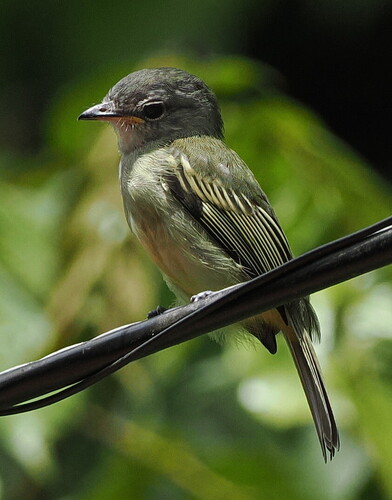 Grey-crowned FlatbillTolmomyias poliocephalusThe gray-crowned flatbill is 12 to 12.5 cm (4.7 to 4.9 in) long and weighs about 11 g (0.39 oz).
Learn the Orange-eyed Flatbill in the BeakBrain App
Photo and call practice. Coming soon to iPhone and Android.
Play today's Daily BirdEvery photo and recording on this page is credited to its author under the licence shown. Spotted a problem with this page, or have a better photo? Contribute.