Learn what every symbol on the card means.Full credits and sources at beakbrain.com/symbols
 ForestDomed nestTiny · 12 g
ID tip
Unlike many other species of fairywren, there is no sexual dimorphism as the male and female have the same plumage. The head is a rusty orange colour, the thighs and tail rufous, the back olive brown and the wings brown. The bill is relatively broad compared with other fairywrens and is black in colour. The eyes are dark brown, and the legs pinkish brown. The two subspecies are distinguishable by their underparts, which are cream-white in C. i. insignis and more ochre-coloured in C.i. oorti.
Text from Wikipedia, licensed CC BY-SA 4.0.
When to see the Orange-crowned Fairywren
One bar for each month. Filled bars are the 6 months with records; pale bars are months with none. The wide bar is August, the month with the most records.
Where to see the Orange-crowned Fairywren
The map shades 2 countries with regular records. Everything unshaded has no records. Countries are listed below the map.
About the Orange-crowned Fairywren
The orange-crowned fairywren is a species of passerine bird in the Australasian wren family, Maluridae. It is monotypic within the genus Clytomyias. It is found on New Guinea in its natural habitat of subtropical or tropical moist montane forests.
Text adapted from Wikipedia, licensed CC BY-SA 4.0.
Easily confused with
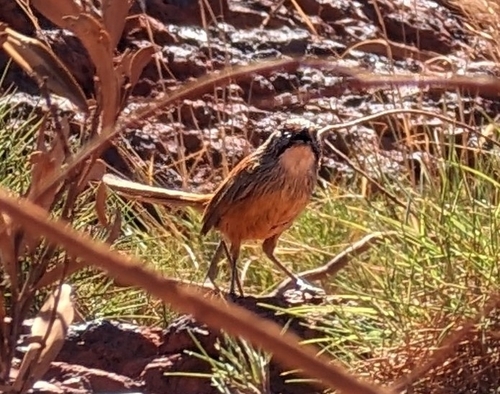
 Carpentarian GrasswrenAmytornis dorotheaeThe Carpentarian grasswren is a species of bird in the family Maluridae.
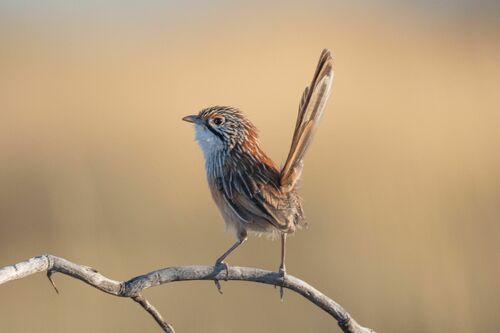
 Pilbara GrasswrenAmytornis whiteiThe Pilbara grasswren, also known as the rufous grasswren, is an insectivorous bird in the Australasian wren family Maluridae.
 Opalton GrasswrenAmytornis rowleyiThe Opalton grasswren is the only grasswren in its range.
Learn the Orange-crowned Fairywren in the BeakBrain App
Photo and call practice. Coming soon to iPhone and Android.
Play today's Daily BirdEvery photo and recording on this page is credited to its author under the licence shown. Spotted a problem with this page, or have a better photo? Contribute.