Learn what every symbol on the card means.Full credits and sources at beakbrain.com/symbols
 ForestSmall · 18 g
ID tip
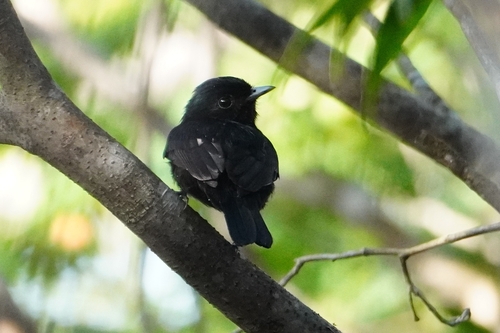
The olive manakin is 13 to 13.5 cm (5.1 to 5.3 in) long and weighs 16.5 to 21 g (0.58 to 0.74 oz). Unusual for a manakin, the sexes have the same plumage. The species also has longer wings and tail relative to its size than many other manakins. Adults of the nominate subspecies have dark olive upperparts. Their throat and underparts are a slightly paler olive and their belly has a yellowish cast. Subspecies X. u. duidae is slightly smaller and brighter than the nominate. Both subspecies have a dark iris, bill, and legs and feet. Voice: The olive manakin's "advertising call" is "a clear, rising whistle, preeeeeeeeEE, penetrating but not loud". It is sometimes preceded by "a few low, stuttery stu-tu-tu-tu-tu notes given quickly, or a short chip note".
Text from Wikipedia, licensed CC BY-SA 4.0.
When to see the Olive Manakin
One bar for each month. Filled bars are the 9 months with records; pale bars are months with none. The wide bar is February, the month with the most records.
Where to see the Olive Manakin
The map shades 2 countries with regular records, and 1 more in a lighter tone where the bird turns up only as a stray. Everything unshaded has no records. Countries are listed below the map.
Recorded as a rare visitor in Brazil.
About the Olive Manakin
The olive manakin is a species of bird in the family Pipridae. It is found in Brazil, Guyana, and Venezuela.
Text adapted from Wikipedia, licensed CC BY-SA 4.0.
Easily confused with
Learn the Olive Manakin in the BeakBrain App
Photo and call practice. Coming soon to iPhone and Android.
Play today's Daily BirdEvery photo and recording on this page is credited to its author under the licence shown. Spotted a problem with this page, or have a better photo? Contribute.