Learn what every symbol on the card means.Full credits and sources at beakbrain.com/symbols
 ForestScrapeHuge · 5.5 kg


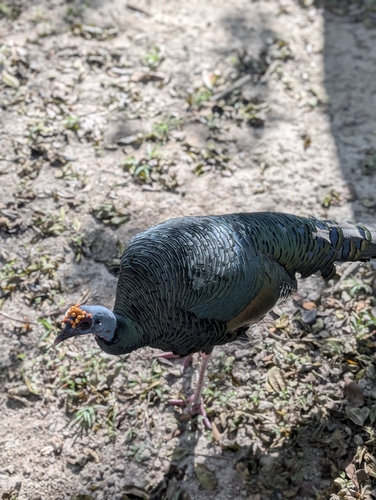
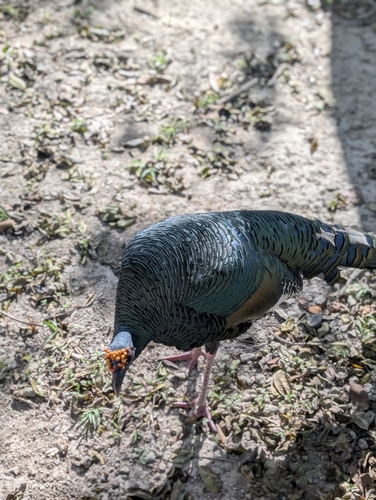
ID tip
The body feathers of both sexes are a mixture of bronze and green iridescent color. Although females can be duller with more green, the breast feathers do not generally differ and cannot be used to determine sex. Neither sex possesses the "beard" typically found in wild turkeys. Tail feathers of both sexes are bluish-grey with an eye-shaped, blue-bronze spot near the end with a bright gold tip. The spots, or ocelli (located on the tail), for which the ocellated turkey is named, have been likened to the patterning typically found on peafowl.
Text from Wikipedia, licensed CC BY-SA 4.0.
When to see the Ocellated Turkey
One bar for each month. Filled bars are the 11 months with records; pale bars are months with none. The wide bar is March, the month with the most records.
Where to see the Ocellated Turkey
The map shades 3 countries with regular records. Everything unshaded has no records. Countries are listed below the map.
About the Ocellated Turkey
The ocellated turkey is a species of turkey residing primarily in the Yucatán Peninsula, Mexico, as well as in parts of Belize and Guatemala. A relative of the North American wild turkey, it was sometimes previously considered in a genus of its own (Agriocharis), but the differences between the two turkeys are currently considered too small to justify generic segregation. It is a relatively large bird, at around 70–122 cm (28–48 in) long and an average weight of 3 kg (6.6 lb) in females and 5 kg (11 lb) in males.
Text adapted from Wikipedia, licensed CC BY-SA 4.0.
Easily confused with

Side by side: Ocellated Turkey vs Wild Turkey
Learn the Ocellated Turkey in the BeakBrain App
Photo and call practice. Coming soon to iPhone and Android.
Play today's Daily BirdEvery photo and recording on this page is credited to its author under the licence shown. Spotted a problem with this page, or have a better photo? Contribute.