Learn what every symbol on the card means.Full credits and sources at beakbrain.com/symbols
 Grassland
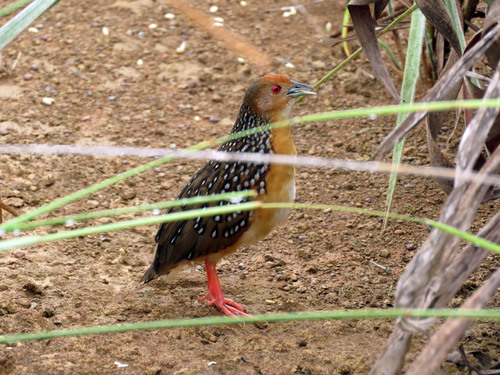
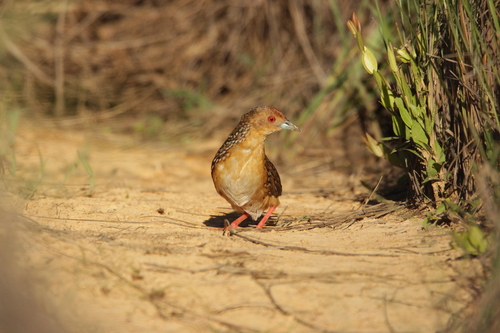
ID tip
The ocellated crake is generally around 165mm long, and is sexually dimorphic in size, with males weighing roughly 40 grams and females 24 grams. Its plumage consists of an overall cinnamon color on the face, breast and belly. Its wings, nape and tail are a darker brown, while the crown has more of an orange hue. Some observers have suggested that the crown color is another sexually dimorphic trait. There is also a varying degree of cream or white on the throat and underparts. The nape, back, wing coverts and rump are mottled by distinctive white spots, each surrounded by a black ring. Voice: The ocellated crake's most recognizable vocalization is its song, referred to as a trill. Its trill consists of a series of loud "pr pr pr" notes, lasting between 20 and 30 seconds. The trill's pitch rises at the start and then stabilizes. This trill will sometimes be followed by a series of "crying" notes, which are raspier and more drawn-out, such as "pjrrr" or "prrrxzzz".
Text from Wikipedia, licensed CC BY-SA 4.0.
About the Ocellated Crake
The ocellated crake is a small terrestrial species of bird in the family Rallidae that is native to the grassland and savanna habitats of Central America and South America. Though it is not often seen, it is easily recognizable by its cinnamon plumage with black and white mottling. This species was formerly placed in its own genus Micropygia .
Text adapted from Wikipedia, licensed CC BY-SA 4.0.
Easily confused with
 Black-banded CrakeRufirallus fasciatusThe black-banded crake is 17 to 20 cm (6.7 to 7.9 in) long.
 Red-and-white CrakeRufirallus leucopyrrhusThe red-and-white crake is 14 to 17 cm (5.5 to 6.7 in) long and weighs 34 to 52 g (1.2 to 1.8 oz) with an average of about 45 g (1.6 oz)).
Rufous-faced CrakeRufirallus xenopterusThe rufous-faced crake is about 14 cm (5.5 in) long and weighs about 52 g (1.8 oz).
Red-and-white CrakeRufirallus leucopyrrhusThe red-and-white crake is 14 to 17 cm (5.5 to 6.7 in) long and weighs 34 to 52 g (1.2 to 1.8 oz) with an average of about 45 g (1.6 oz)).
Rufous-faced CrakeRufirallus xenopterusThe rufous-faced crake is about 14 cm (5.5 in) long and weighs about 52 g (1.8 oz).
Learn the Ocellated Crake in the BeakBrain App
Photo and call practice. Coming soon to iPhone and Android.
Play today's Daily BirdEvery photo and recording on this page is credited to its author under the licence shown. Spotted a problem with this page, or have a better photo? Contribute.