Learn what every symbol on the card means.Full credits and sources at beakbrain.com/symbols
 ForestCavity nestSmall · 50 g
ID tip
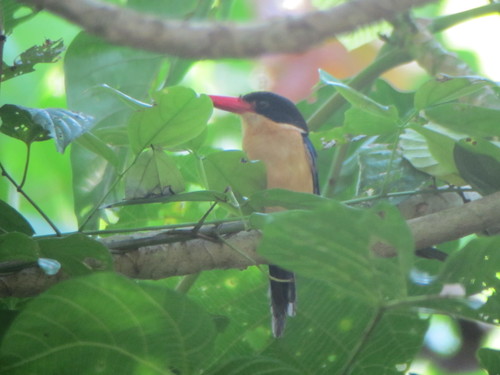
The Numfor paradise kingfisher grows to a length of 34 to 38 cm (13 to 15 in) including its long tail. The sexes look alike and have purplish-blue upper parts and similarly coloured underparts, with the lower back, rump, vent region and tail being white. The iris is brown, the bill red and the legs and feet greenish-brown. The juvenile has duller purple-blue plumage with rufous and buff underparts, a white rump and blackish tail. The voice is said to be similar to the call of the common cuckoo (Cuculus canorus).
Text from Wikipedia, licensed CC BY-SA 4.0.
When to see the Numfor Paradise Kingfisher
One bar for each month. Filled bars are the 4 months with records; pale bars are months with none. The wide bar is July, the month with the most records.
Where to see the Numfor Paradise Kingfisher
The map shades 1 country with regular records. Everything unshaded has no records. Countries are listed below the map.
About the Numfor Paradise Kingfisher
The Numfor paradise kingfisher, also known as the cobalt paradise kingfisher, is a tree kingfisher endemic to the Indonesian island of Numfor off the northwestern coast of New Guinea. It is a common species, but the forests where it lives are being affected by logging and the IUCN has rated its conservation status as "near-threatened".
Text adapted from Wikipedia, licensed CC BY-SA 4.0.
Easily confused with
 Little Paradise KingfisherTanysiptera hydrocharisIt is similar to the common paradise kingfisher, albeit smaller.
 Black-capped Paradise KingfisherTanysiptera nigricepsThe black-capped paradise kingfisher is 35–48 cm (14–19 in) in overall length including the tail streamers and weighs from 43 to 74 g (1.5 to 2.6 oz).
Learn the Numfor Paradise Kingfisher in the BeakBrain App
Photo and call practice. Coming soon to iPhone and Android.
Play today's Daily BirdEvery photo and recording on this page is credited to its author under the licence shown. Spotted a problem with this page, or have a better photo? Contribute.