Learn what every symbol on the card means.Full credits and sources at beakbrain.com/symbols
 ForestPlatform nestLarge · 507 g


ID tip
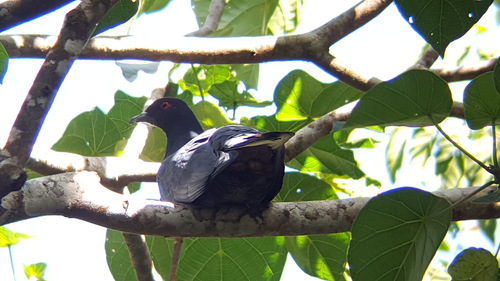
This is the largest pigeon outside of the crowned pigeons, as it weighs approximately 900 g (2.0 lb). Females, at 50 to 53.5 cm (19.7 to 21.1 in) long, are slightly smaller than males, at 55 cm (22 in) in length. Among standard measurements, the wing chord is 27.8–32.1 cm (10.9–12.6 in), the tail is 18.1–23.1 cm (7.1–9.1 in), the bill is 1.9–2.7 cm (0.75–1.06 in) and the tarsus is 3.9–4.6 cm (1.5–1.8 in). This species is heavily built with a large bill and long, broad tail. The wings are broad and rounded in shape.
Text from Wikipedia, licensed CC BY-SA 4.0.
When to see the Nuku Hiva Imperial Pigeon
One bar for each month. Filled bars are the 7 months with records; pale bars are months with none. The wide bar is May, the month with the most records.
Where to see the Nuku Hiva Imperial Pigeon
The map shades 1 country with regular records. Everything unshaded has no records. Countries are listed below the map.
About the Nuku Hiva Imperial Pigeon
The Nuku Hiva imperial pigeon, also known as the Marquesan imperial pigeon or Upe, is a pigeon which is endemic to Nuku Hiva in the Marquesas Islands of French Polynesia, now restricted to some valleys in the western part of that island; following successful reintroductions of birds in 2000 and 2003, there is now an established population on Ua Huka. With its small distribution, scientists now believe it has probably never been common, but its small population has marked it as an endangered species since 2008.
Text adapted from Wikipedia, licensed CC BY-SA 4.0.
Easily confused with
 Black Imperial PigeonDucula melanochroaThe black imperial pigeon is a large, heavily built, long-tailed species for its genus, with a length of 38–43 cm (15–17 in) and a weight of 661–665 g (23.3–23.5 oz).
Learn the Nuku Hiva Imperial Pigeon in the BeakBrain App
Photo and call practice. Coming soon to iPhone and Android.
Play today's Daily BirdEvery photo and recording on this page is credited to its author under the licence shown. Spotted a problem with this page, or have a better photo? Contribute.