Learn what every symbol on the card means.Full credits and sources at beakbrain.com/symbols
 ForestMedium · 80 g


ID tip
The northern hawk-cuckoo is one of the smallest in the genus Hierococcyx at 28-30 cm in length, a weight between 99.0-147.8 g, and an average wing length of 20.2 cm, although measurements can vary slightly between sexes. Both sexes sport similar colouring with rump, back, and wings slate grey and underparts rusty red. Inner flight feathers form a white patch on folded wings when perched. Some individuals sport white patch on nape from juvenile feathering. Head and upper cheeks slate grey with a white throat and grey chin, lower cheeks rusty red blending into rest of underparts. Voice: Most vocal during overcast weather, at twilight, or during breeding season when calling is heard at all hours of the night and day. All hawk-cuckoos produce two vocalization types, a song and a “long call”. The northern hawk-cuckoo song is a two part buzzy whistle, “weeweepeeit" or “weeweepeeweit”. The first note is held for 0.3 s at 3kHz, then the second notes drops and rises at the end to 4kHz.
Text from Wikipedia, licensed CC BY-SA 4.0.
When to see the Northern Hawk-Cuckoo
One bar for each month. Filled bars are the 5 months with records; pale bars are months with none. The wide bar is May, the month with the most records.
Where to see the Northern Hawk-Cuckoo
The map shades 6 countries with regular records, and 1 more in a lighter tone where the bird turns up only as a stray. Everything unshaded has no records. Countries are listed below the map.
Recorded as a rare visitor in Malaysia.
About the Northern Hawk-Cuckoo
The northern hawk-cuckoo or rufous hawk-cuckoo is a species of cuckoo found in eastern China, North and South Korea, far eastern Russia, and Japan. Northern populations migrate to overwinter in Borneo. This elusive species is considered rare over most of its range and many of its life history traits remain understudied. It is known to perch in the crowns of tall trees, making direct observation difficult.
Text adapted from Wikipedia, licensed CC BY-SA 4.0.
Easily confused with
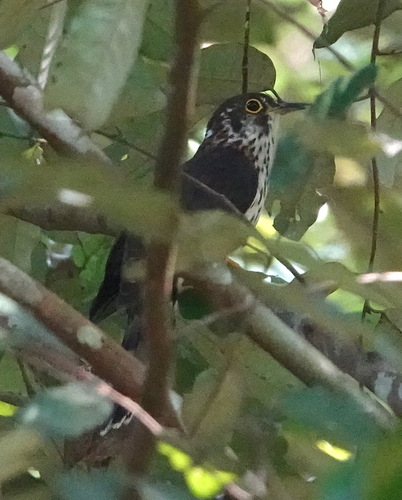 Moustached Hawk-CuckooHierococcyx vagansThe moustached hawk-cuckoo is 25–30 cm (9.8–11.8 in) long, and it weighs about 58–63 g (2.0–2.2 oz).
Malaysian Hawk-CuckooHierococcyx fugaxThe Malaysian hawk-cuckoo or Malay hawk-cuckoo is a bird in the family Cuculidae formerly considered conspecific with Hodgson's hawk-cuckoo and the rufous hawk-cuckoo.
Moustached Hawk-CuckooHierococcyx vagansThe moustached hawk-cuckoo is 25–30 cm (9.8–11.8 in) long, and it weighs about 58–63 g (2.0–2.2 oz).
Malaysian Hawk-CuckooHierococcyx fugaxThe Malaysian hawk-cuckoo or Malay hawk-cuckoo is a bird in the family Cuculidae formerly considered conspecific with Hodgson's hawk-cuckoo and the rufous hawk-cuckoo.
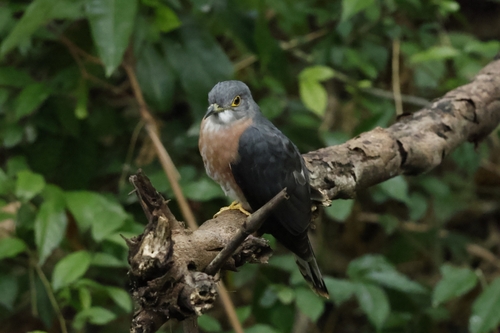 Philippine Hawk-CuckooHierococcyx pectoralisThe Philippine hawk-cuckoo is a bird belonging to the cuckoo family.
Learn the Northern Hawk-Cuckoo in the BeakBrain App
Photo and call practice. Coming soon to iPhone and Android.
Play today's Daily BirdEvery photo and recording on this page is credited to its author under the licence shown. Spotted a problem with this page, or have a better photo? Contribute.