Learn what every symbol on the card means.Full credits and sources at beakbrain.com/symbols
 ForestCavity nestMedium · 225 g


ID tip
Ninox japonica is a hawk owl species with a body length averaging between 29 and 33 cm and a wingspan of approximately 60 to 70 cm wide. Current knowledge on the species shows no sexual dimorphism and an average weight of approximately 168g. The northern boobook has a hawk-like appearance and its subspecies are practically indistinguishable. Individuals of the species will have a brown back and wings with lighter brown horizontal streaks on the tail feathers. The neck, crown and face of this bird are slightly more greyish brown aside from a small white patch above the beak. Voice: Northern boobooks vocalize through a sequence of deep ho-hos and this behavior is specific to breeding individuals during their reproductive periods. Correspondingly, the vocalization of N. japonica is seldom heard in regions where it is migrant or a winter resident.
Text from Wikipedia, licensed CC BY-SA 4.0.
When to see the Northern Boobook
One bar for each month. Filled bars are the 7 months with records; pale bars are months with none. The wide bar is June, the month with the most records.
Where to see the Northern Boobook
The map shades 13 countries with regular records, and 2 more in a lighter tone where the bird turns up only as a stray. Everything unshaded has no records. Countries are listed below the map.
Recorded as a rare visitor in United States, Australia.
About the Northern Boobook
The northern boobook belongs to the family Strigidae and is a raptorial owl endemic to eastern and southern countries of Asia. The species was considered, until recently, a conspecific of Ninox scutulata or brown boobook, a species of similar distribution encompassing 11 subspecies. The species currently includes two subspecies, the migrant Ninox japonica japonica and the non-migrant Ninox japonica totogo. Despite being considered as the most common breeding owl in Japan, little research has been conducted on the species and subspecies and the taxonomic classification of N. j. totogo and N. j. japonica has been a subject of debate.
Text adapted from Wikipedia, licensed CC BY-SA 4.0.
Easily confused with
 MoreporkNinox novaeseelandiaeThe morepork is 26 to 29 cm (10 to 11.5 in) long, with the female slightly larger than the male.
 Australian BoobookNinox boobookThe smallest owl on the Australian mainland, the Australian boobook is 27 to 36 cm (10.5 to 14 in) long.
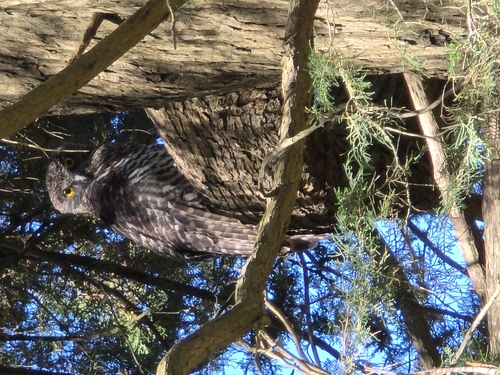 Powerful OwlNinox strenuaThe powerful owl has a long tail and a small head, giving it an atypical silhouette for an owl and imparting a more hawk-like appearance than any other large owl.
Side by side: Northern Boobook vs Northern Hawk-Owl · Morepork vs Northern Boobook · Australian Boobook vs Northern Boobook · Northern Boobook vs Powerful Owl
Learn the Northern Boobook in the BeakBrain App
Photo and call practice. Coming soon to iPhone and Android.
Play today's Daily BirdEvery photo and recording on this page is credited to its author under the licence shown. Spotted a problem with this page, or have a better photo? Contribute.