Learn what every symbol on the card means.Full credits and sources at beakbrain.com/symbols
 RockyPlatform nestLarge · 1.2 kg


ID tip
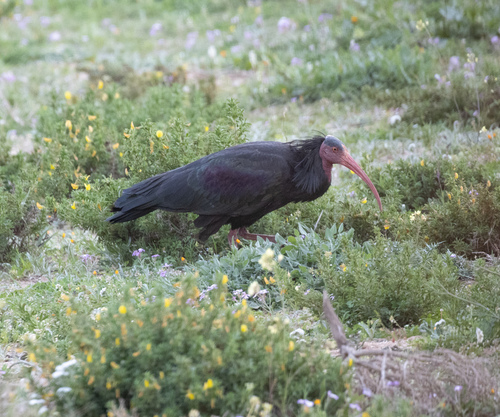
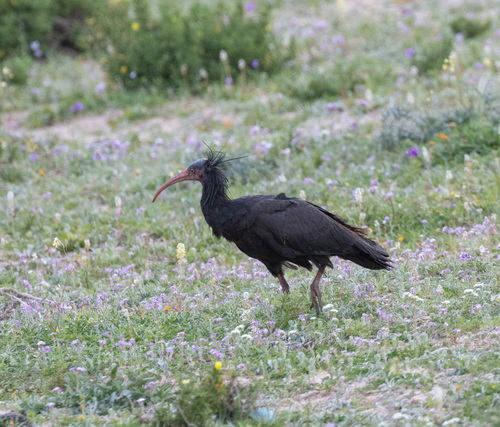
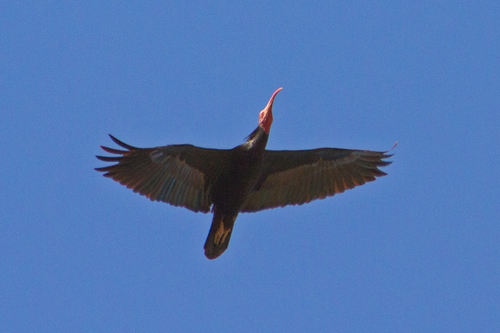
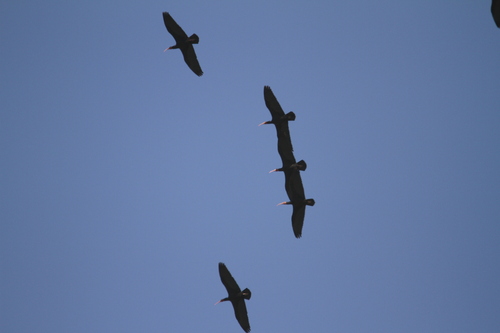
The northern bald ibis is a large, glossy black bird, 70–80 cm (28–31 in) long with a 125–135 cm (49–53 in) wingspan and an average weight of 1.0–1.3 kg (35–46 oz). The plumage is black, with bronze-green and violet iridescence, and there is a wispy ruff on the bird's hind neck. The face and head are dull red and unfeathered, and the long, curved bill and the legs are red. In flight, this bird has powerful, shallow, and flexible wing beats. It gives guttural hrump and high, hoarse hyoh calls at its breeding colonies, but is otherwise silent.
Text from Wikipedia, licensed CC BY-SA 4.0.
When to see the Northern Bald Ibis
One bar for each month. Filled bars are the 11 months with records; pale bars are months with none. The wide bar is April, the month with the most records.
Where to see the Northern Bald Ibis
The map shades 14 countries with regular records, and 6 more in a lighter tone where the bird turns up only as a stray. Everything unshaded has no records. Countries are listed below the map.
Recorded as a rare visitor in France, Belgium, Portugal, Denmark, United Kingdom, Netherlands.
About the Northern Bald Ibis
The northern bald ibis, hermit ibis, or Waldrapp is a migratory Old World ibis found in open areas such as grasslands, rocky mountains, and semi-deserts, often close to running water. This 70–80 cm (28–31 in) glossy black ibis, which, unlike many members of the ibis family, is non-wading, has an unfeathered red face and head, and a long, curved red bill. It breeds colonially on coastal or mountain cliff ledges, where it typically lays two to three eggs in a stick nest, and feeds on lizards, insects, and other small animals.
Text adapted from Wikipedia, licensed CC BY-SA 4.0.
Easily confused with

Side by side: Northern Bald Ibis vs Southern Bald Ibis · Northern Bald Ibis vs Sharp-tailed Ibis
Learn the Northern Bald Ibis in the BeakBrain App
Photo and call practice. Coming soon to iPhone and Android.
Play today's Daily BirdEvery photo and recording on this page is credited to its author under the licence shown. Spotted a problem with this page, or have a better photo? Contribute.