Learn what every symbol on the card means.Full credits and sources at beakbrain.com/symbols
 ForestCavity nestMedium · 75 g


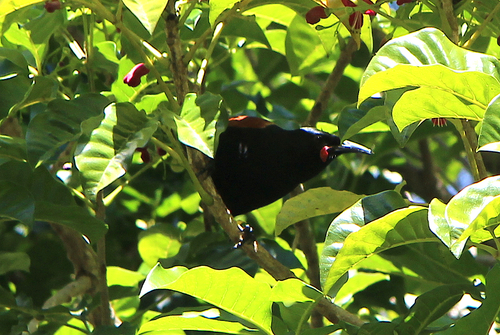
ID tip
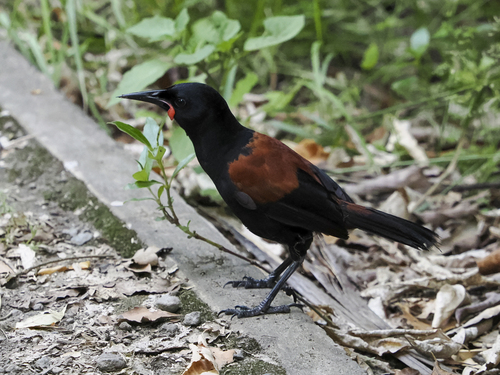
The plumage of North Island saddlebacks is mostly black apart from the saddle, rump, and tail coverts, which are chestnut. North Island saddlebacks are distinguished from South Island saddlebacks by a faint yellow lining on the superior edge of the saddle. The black bill is starling-like, with orange-red wattles hanging from its base. North Island saddlebacks have an average length of 25 cm. Males tend to be heavier (80 g) than females (69 g), and possess longer bills and larger wattles. North Island saddlebacks produce calls described as "cheet, te-te-te-te" or "ti-e-ke-ke-ke-ke".
Text from Wikipedia, licensed CC BY-SA 4.0.
When to see the North Island Saddleback
One bar for each month. Filled bars are the 8 months with records; pale bars are months with none. The wide bar is January, the month with the most records.
Where to see the North Island Saddleback
The map shades 1 country with regular records. Everything unshaded has no records. Countries are listed below the map.
About the North Island Saddleback
The North Island saddleback is a forest-dwelling passerine bird species endemic to the North Island of New Zealand. It was once considered conspecific with the South Island saddleback. The IUCN lists the species as Near Threatened, while it is listed as a "relict" species in the New Zealand Threat Classification System. Saddlebacks are known in Māori as tīeke.
Text adapted from Wikipedia, licensed CC BY-SA 4.0.
Easily confused with
Learn the North Island Saddleback in the BeakBrain App
Photo and call practice. Coming soon to iPhone and Android.
Play today's Daily BirdEvery photo and recording on this page is credited to its author under the licence shown. Spotted a problem with this page, or have a better photo? Contribute.