Learn what every symbol on the card means.Full credits and sources at beakbrain.com/symbols
 ForestPlatform nestLarge · 538 g


ID tip
It is a large pigeon, measuring 32–35 cm (13–14 in) in length. The head is grey, like the upper neck plumage, which turns into green and copper hackles. The tail is short and pure white. The rest of its plumage is metallic green, appearing black in dull light. The cere of the dark bill forms a small blackish knob; the strong legs and feet are dull red. The irises are dark. Females, weighing 490–600 g, are on average slightly larger than the 460–525 g males, but with much overlap; they have a smaller bill knob, shorter hackles and browner underparts.
Text from Wikipedia, licensed CC BY-SA 4.0.
When to see the Nicobar Pigeon
One bar for each month, and every month is filled: this bird is recorded here in all twelve. The wide bar is March, the month with the most records.
Where to see the Nicobar Pigeon
The map shades 10 countries with regular records, and 2 more in a lighter tone where the bird turns up only as a stray. Everything unshaded has no records. Countries are listed below the map.
About the Nicobar Pigeon
The Nicobar pigeon or Nicobar dove is a bird found on small islands and in coastal regions from the Andaman and Nicobar Islands, India, east through the Indonesian Archipelago, to the Solomons and Palau. It is the only living member of the genus Caloenas alongside the extinct spotted green pigeon and Kanaka pigeon, and is the closest living relative of the extinct dodo and Rodrigues solitaire.
Text adapted from Wikipedia, licensed CC BY-SA 4.0.
Easily confused with
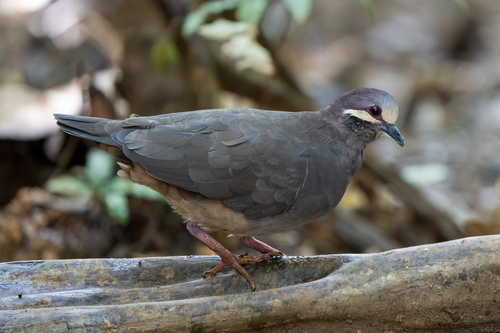 Olive-backed Quail-DoveLeptotrygon veraguensisThe male olive-backed quail-dove is 21 to 24.5 cm (8.3 to 9.6 in) long and the female 21 to 22 cm (8.3 to 8.7 in).
 Stephan's Emerald DoveChalcophaps stephaniStephan's emerald dove, also known as Stephan's dove, is a species of bird in the pigeon family Columbidae.
 Mariana Fruit DovePtilinopus roseicapillaThe Mariana fruit dove, totot in the Northern Marianas Islands or Paluman totut on Guam, also known as mwee'mwe in the Carolinian language, is a small, up to 24 cm (9.4 in) long, green fruit dove native and endemic to the Northern Marianas Islands in the Pacific and Guam.
Learn the Nicobar Pigeon in the BeakBrain App
Photo and call practice. Coming soon to iPhone and Android.
Play today's Daily BirdEvery photo and recording on this page is credited to its author under the licence shown. Spotted a problem with this page, or have a better photo? Contribute.