Learn what every symbol on the card means.Full credits and sources at beakbrain.com/symbols
 ForestMedium · 224 g
ID tip
It is predominantly green with a yellowish-grey head and prominent black facial markings. It has a black stripe from the forehead to the eyes and a broad black band extending from the lower mandible to the sides of the neck. The iris is reddish-orange. The upper mandible is red in males and black in females, while the lower mandible is black in both sexes. Females, in addition, have a higher presence of blue hinted facial feathers. It is listed as Near Threatened by the International Union for Conservation of Nature (IUCN). Very little is known about its ecology.
Text from Wikipedia, licensed CC BY-SA 4.0.
When to see the Nicobar Parakeet
One bar for each month. Filled bars are the 8 months with records; pale bars are months with none. The wide bar is December, the month with the most records.
Where to see the Nicobar Parakeet
The map shades 1 country with regular records. Everything unshaded has no records. Countries are listed below the map.
About the Nicobar Parakeet
The Nicobar parakeet, also known as Blyth's parakeet, is a parrot in the genus Psittacula, endemic to the Nicobar Islands of the Indian Ocean. It is one of the largest parakeets, measuring 56 to 60 cm from the top of the head to the tip of the tail and weighing about 224 g.
Text adapted from Wikipedia, licensed CC BY-SA 4.0.
Easily confused with
 Echo ParakeetPsittacula equesThe echo parakeet is 34–42 cm (13–17 in) long and weighs 167–193 g (5.9–6.8 oz), which makes it smaller than the other, now extinct, Mauritian parrots.
 Lord Derby's ParakeetPsittacula derbianaLord Derby's parakeets are 45–50 cm (18–20 in) in length and are sexually dimorphic.
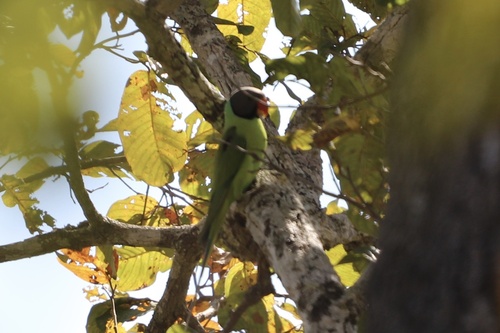 Grey-headed ParakeetPsittacula finschiiIts face is grey/green, and the rest of its head is dull green with faint pale green band below cheeks to hindcrown and its wing are patch absent and has a long tail.
Learn the Nicobar Parakeet in the BeakBrain App
Photo and call practice. Coming soon to iPhone and Android.
Play today's Daily BirdEvery photo and recording on this page is credited to its author under the licence shown. Spotted a problem with this page, or have a better photo? Contribute.