Learn what every symbol on the card means.Full credits and sources at beakbrain.com/symbols
 ForestCavity nestTiny · 5 g
What the Neblina Metaltail sounds like

ID tip
The neblina metaltail is 9 to 10.5 cm (3.5 to 4.1 in) long. Males weigh about 5.2 g (0.18 oz) and females about 4.8 g (0.17 oz). It has a medium length, straight, black bill. The adult male has iridescent dark green upperparts. Its slightly forked tail is dark olive green on its upper side and shining golden green on its underside. The sides of its head and neck vary from bronzy olive to coppery bronze and its gorget is reddish purple to rosy red. The rest of its underparts are olive bronze with a buffy spotted appearance. Its undertail coverts are bronzy green with buffy cinnamon edges. Voice: The neblina metaltail's vocalizations have variously been described as "a rather loud seet-seet-seet-ti-tttt...and 'a jerky, wiry chatter'."
Text from Wikipedia, licensed CC BY-SA 4.0.
When to see the Neblina Metaltail
One bar for each month. Filled bars are the 11 months with records; pale bars are months with none. The wide bar is January, the month with the most records.
Where to see the Neblina Metaltail
The map shades 2 countries with regular records. Everything unshaded has no records. Countries are listed below the map.
About the Neblina Metaltail
The neblina metaltail, locally called metalura neblina or colibrí de neblina, is a species of hummingbird in the "coquettes", tribe Lesbiini of subfamily Lesbiinae. It is found in Ecuador and Peru.
Text adapted from Wikipedia, licensed CC BY-SA 4.0.
Easily confused with
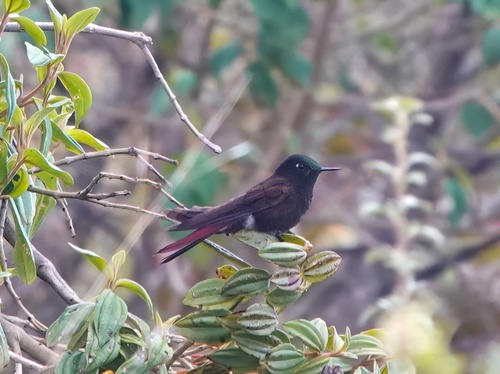 Perija MetaltailMetallura iracundaThe Perijá metaltail is 10 to 11 cm (3.9 to 4.3 in) long and weighs 3.6 to 4.1 g (0.13 to 0.14 oz).
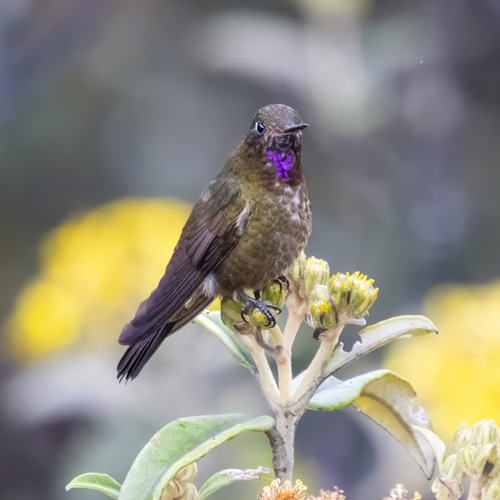 Violet-throated MetaltailMetallura baroniThe violet-throated metaltail is 10 to 11 cm (3.9 to 4.3 in) long.
Learn the Neblina Metaltail in the BeakBrain App
Photo and call practice. Coming soon to iPhone and Android.
Play today's Daily BirdEvery photo and recording on this page is credited to its author under the licence shown. Spotted a problem with this page, or have a better photo? Contribute.